Fire Extinguisher Calculator: How Many Do You Need?
Use this calculator to estimate how many portable fire extinguishers your premises need and which types suit the fire risks on site. Enter the floor area of each storey and tick the hazards you have. The result is a starting point for a quote and for your conversation with the local fire department or a SAQCC Fire registered service company.
Calculate your fire extinguishers
Enter your figures to see the result.
How the calculation works
The calculator divides the floor area of each storey by the area one extinguisher is expected to cover, rounds up and allows at least one unit per storey. South African buildings follow SANS 10400-T (fire protection) and SANS 10105-1 (use and control of portable fire extinguishers), and a widely used guideline is one extinguisher for every 200 m² of floor area. Higher-risk areas, large stores of flammable stock and workshops need closer spacing, so you can choose 150 m² or 100 m² instead.
Specialist risks are added on top of the general cover: a wet chemical (Class F) extinguisher and a fire blanket for each kitchen with cooking oil, a CO2 extinguisher for each server room or main electrical room, and a small DCP unit for each vehicle. Your local fire department has the final say on the number, type and position of extinguishers, and may ask for hose reels too.
Choosing the right type of extinguisher
| Fire class | What burns | Suitable extinguishers |
|---|---|---|
| A | Paper, wood, cloth, plastics | DCP (ABC powder), water, foam |
| B | Flammable liquids: petrol, diesel, paint, solvents | DCP, foam, CO2 |
| C | Flammable gases such as LPG | DCP (and shut off the gas supply) |
| D | Combustible metals: magnesium, aluminium swarf | Special Class D powder only |
| F | Cooking oils and fats | Wet chemical, fire blanket |
| Electrical | Live electrical equipment | CO2 or DCP (never water or foam) |
A 9 kg dry chemical powder (DCP) extinguisher covers classes A, B and C and is the most common choice in South African workplaces. CO2 leaves no residue, so it suits offices, server rooms and electrical panels, but it does little against deep-seated Class A fires. Never use water or foam on a fat fire or on live electrical equipment.
Positioning and servicing
Mount extinguishers on brackets near exits and escape routes, close to the specific hazard, with the handle at a height most people can reach, and mark each position with a photoluminescent sign so it can be found in smoke. Keep the walking distance to the nearest unit short and never block access with stock. Every portable extinguisher must be serviced by a SAQCC Fire registered technician in line with SANS 1475, normally every 12 months, and after any use. Add the total from this calculator to your service contract so nothing is missed.
This tool gives an estimate for planning and budgeting. It does not replace a risk assessment or the advice of your local fire department or a registered fire protection practitioner.
Need fire extinguishers?
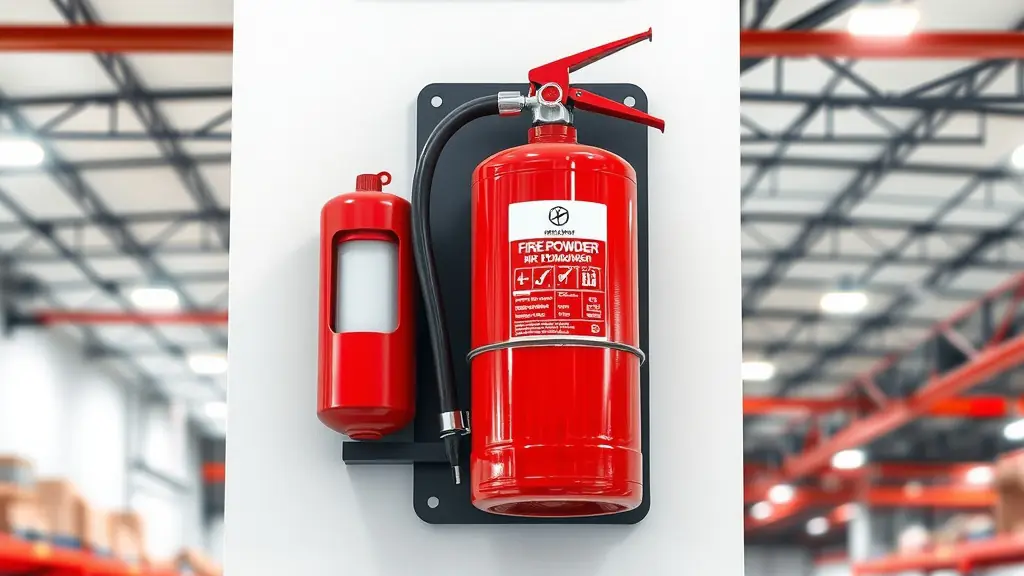 Fire Extinguishers: types, standards and how to get a quote
Frequently asked questions
- How many fire extinguishers do I need per square metre?
- A common guideline is at least one extinguisher for every 200 m² of floor area, with a minimum of one per storey, and closer spacing for higher-risk areas. Specialist hazards such as kitchens and server rooms need their own units on top of that.
- What size fire extinguisher is best for a business?
- A 9 kg DCP extinguisher is the standard general-purpose unit for South African workplaces. Add 5 kg CO2 units near electrical equipment and a wet chemical unit in kitchens.
- How often must fire extinguishers be serviced in South Africa?
- At least once every 12 months by a SAQCC Fire registered technician to SANS 1475, and immediately after any discharge. Pressure testing is done at longer intervals set by the standard.