Fall Clearance Calculator for Safety Harnesses
A safety harness only saves a life if the worker stops before hitting the ground or a lower structure. Enter your lanyard or inertia reel details and the anchor position, and this calculator works out the free fall distance and the minimum clear height needed below the working surface. Compare it with the clearance you actually have before anyone works at height.
Calculate required fall clearance
Enter your figures to see the result.
How fall clearance is worked out
The clearance needed below the working surface is the sum of four distances:
- Free fall: how far the worker drops before the lanyard goes tight. It equals the lanyard length plus the D-ring height minus the anchor height. An anchor at foot level with a 2 m lanyard gives 3.5 m of free fall; an overhead anchor cuts it sharply.
- Deceleration: how far the energy absorber tears out, up to 1.75 m under EN 355 (SANS 50355), or the arrest distance of an inertia reel.
- Harness stretch and D-ring slide: typically about 0.3 m.
- Safety margin: usually 1 m so the feet stop clear of the ground or structure below.
Because the feet start at the working surface, these four add up to the clear height you need below it. If the result is more than the clearance you have, use a higher anchor, a shorter lanyard or an inertia reel, or switch to fall restraint so the worker cannot reach the edge at all.
Anchors, swing falls and rescue
Anchor points should be directly above the worker where possible. Working sideways from the anchor creates a swing fall, which adds distance and can slam the worker into a structure. Anchors below the D-ring increase free fall and the force on the body, so check that your energy absorber is rated for the free fall distance (many are rated for up to 4 m) and that an inertia reel is approved for edge use if it is anchored at foot level. The Construction Regulations of 2014 require a fall protection plan, which must include a rescue plan: a worker hanging in a harness can suffer suspension trauma within minutes.
This tool gives an estimate for planning and budgeting. It does not replace a risk assessment or the advice of a competent fall protection planner.
Need safety harnesses?
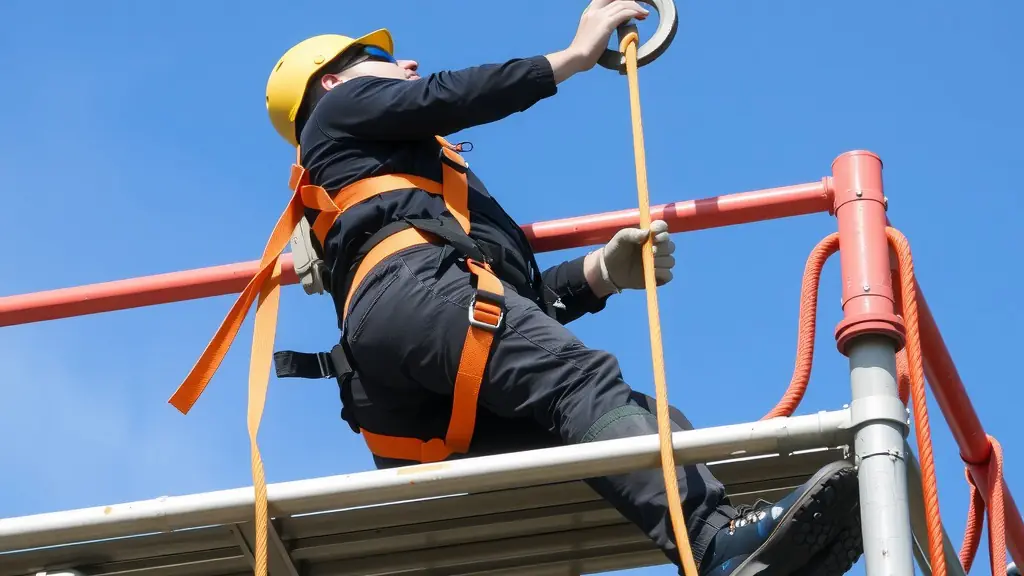 Safety Harnesses: types, standards and how to get a quote
Frequently asked questions
- How much clearance do I need with a 2 m lanyard?
- Anchored at foot level, about 6.5 m below the working surface (3.5 m free fall, 1.75 m absorber, 0.3 m stretch and 1 m margin). With an overhead anchor 2 m above the surface it drops to about 4.5 m.
- Is an inertia reel better than a lanyard for low heights?
- Usually yes. An inertia reel locks within a short distance, so it needs much less clearance than an energy-absorbing lanyard, which can need over 6 m.
- What is the maximum free fall distance?
- Keep free fall as short as possible, ideally under 2 m with an overhead anchor. Never exceed the free fall rating of the energy absorber, which is commonly 4 m for absorbers tested for foot-level anchors.