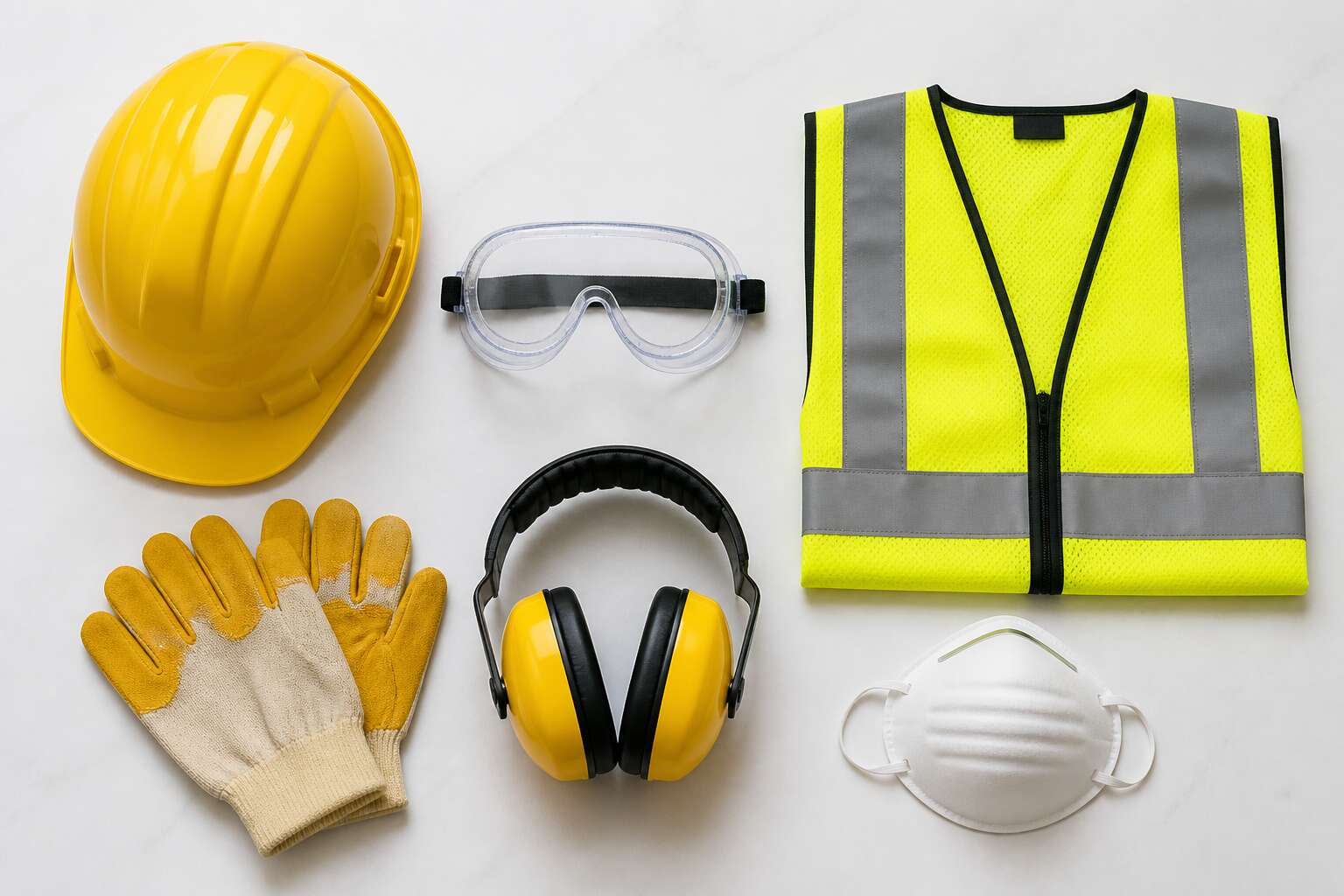
Core Components of a Complete PPE Kit
Head and Face Protection
Securing a hard hat and cinching the chin strap imposes a certain mindfulness. This equipment shields your skin and skull, but it also acknowledges that hazards exist in the same space as routine. A complete ppe equipment kit assigns this responsibility before a single task begins.
Face protection operates on a different level of trust. A polycarbonate shield can stop a flying fragment, yet workers often hesitate. I have watched workers remove helmets the moment a supervisor turns away. The weight, the fogging, the muffled sound of your own breath. These sensations remind you that safety is an ongoing process, not a fixed state.
Typical head and face components include:
- Impact resistant hard hats with adjustable harnesses
- Clear or tinted face shields for grinding and chemical work
- Safety spectacles with side shields
- Welding helmets with auto darkening filters
Each piece answers a specific threat and defines the boundary between exposure and survival.
Respiratory Protection
Breathe in. Now consider what else entered your lungs. On a South African worksite, that breath might carry silica dust, welding fume, or solvent vapour. The ppe equipment kit you assemble must include respiratory protection, because unprotected breathing leads to permanent damage that rarely announces itself in time.
Respiratory gear operates on a simple contract: filter the threat before it reaches you. Disposable respirators suit light dust; half-face units with replaceable cartridges handle chemical exposure. I have watched workers trade a heavy P3 filter for something lighter on a hot afternoon, only to struggle with chest tightness weeks later.
Typical respiratory components include:
- N95 or FFP2 disposable masks for particulate hazards
- Half-face elastomeric respirators with organic vapour cartridges
- Powered air purifying respirators (PAPR) for extended shifts
Each option trades comfort against protection, but none of them work if the seal is broken by a beard or a carelessly tightened strap. That detail deserves your attention before the air does.
Hand and Arm Protection
Hand injuries account for nearly 30% of lost-time incidents on South African worksites. That statistic gains weight when you see a worker peel off a torn glove and reveal skin that should not be on display. Hands reach into every hazard, so the ppe equipment kit must cover them properly.
Skin does not block chemicals. It absorbs them. Solvents, cement dust, and acids pass through unprotected fingers and forearms without warning. A welder fights sparks and molten metal. A mason feels wet cement burning long after the shift ends. A chemical operator may lose nerve function before noticing a splash stain. The right glove depends on the exact threat, not on what is cheapest.
What should a complete ppe equipment kit include for hand and arm protection? The answer shifts with the task, but common components are:
- Nitrile gloves for oils, fuels, and dilute acids
- Leather gauntlets for heat and impact
- Cut-resistant sleeves made from HDPE or Kevlar fibres
- Long-cuff gloves for splash protection during chemical transfers
Every one of these fails without warning. A pinhole in nitrile appears only when the hand swells. A leather palm thins until the grip slips mid-lift. Workers must inspect gloves for punctures, tears, and stiffness before every shift. Arm protection deserves the same scrutiny. A gauntlet that stops at the wrist leaves the forearm exposed to splash and abrasion. The hand carries its own memory; once an injury happens, the fingers never forget. That alone should keep every layer of the ppe equipment kit intact.
Choosing the Right PPE Kit for Your Industry
Healthcare and Medical Applications
In the sterile corridors of a modern medical facility, the margin for error is measured in millimetres and seconds. For the South African healthcare professional, the daily confrontation with biological hazards demands a ppe equipment kit that functions as a silent, unwavering ally. This is not about generic coveralls; it is about a curated armoury against microscopic threats. The selection process begins with a ruthless audit of the clinical environment, considering the specific fluid exposure risks and the required level of barrier protection.
Certification is the first line of defence, a non-negotiable factor that separates trustworthy gear from mere fabric. A reliable ppe equipment kit in this sector must adhere to stringent SANS standards, ensuring that every seam and seal offers verified protection. Consider the essential components for a high-risk ward:
– Fluid-resistant gowns with reinforced cuffs
– Sterile surgical gloves with high tensile strength
– Full-face shields with anti-fog coating
– Single-use aprons for procedures with splash potential
The unpredictable nature of emergency care also calls for versatility. A kit designed for a rural clinic will differ vastly from one used in a private urban hospital, yet both share the same foundational requirement for integrity. When the pressure is on, the last thing a practitioner needs is a failed component. Investing in a layered, task-specific ppe equipment kit is the quiet confidence that allows the mind to focus solely on the patient, ensuring that the healing touch remains safe and uninterrupted.
Construction and Industrial Work
Fatalities on South African construction sites remain a persistent danger. For the worker, a ppe equipment kit selected for this industry must withstand falling debris, abrasive surfaces, and extreme heat. It is not the clean environment of a hospital.
Durability is the priority. Fabrics need to resist tears. High-visibility vests with reflective strips are essential on busy sites. At height, a full-body harness with shock-absorbing lanyards prevents tragedy. A cheap harness is a costly mistake, as I learned on a Johannesburg site.
Demand these components for your industrial kit:
- Reinforced work trousers with knee pads
- Leather gloves with cut-resistant liners
- Safety boots with steel toe caps
- Hi-vis jackets meeting SANS specifications
Inspect every item before each shift. A torn strap can fail. Choosing the right kit affects your safety on every job.
Chemical and Hazardous Material Handling
“Every year, a chemical engineer in Durban told me, ‘we replace workers before we replace gloves.’ No one should make that trade. The adversaries here are invisible. They permeate the skin, or worse, they hide on a surface as a dry powder.
A ppe equipment kit for chemical handling is not armour for a fight. It is a barrier against absorption. It is a membrane between the living body and a reactive world. A chemical burn is a memory etched into tissue.
The baseline for this kit includes:
– Nitrile gloves with a longer cuff, not the short ones that expose the wrist
– A full-face shield or chemical splash goggles, because eyes are the quickest route to injury
– A chemical-resistant apron made from butyl or neoprene
– Boots that resist solvents, not the standard steel toe
Read every label. The chemical dictates the fabric. I asked a plant manager about his best worker. He said, ‘the one who treats his kit like a tombstone. He knows it marks the end of something.’ Invest in the correct ppe equipment kit. Your skin will remember the choice.”
Emergency Response and First Aid
An emergency does not wait for a restock order. A plant manager in Johannesburg once told me, “If your first aid box needs a key, you are already too late!” A ppe equipment kit built for emergency response differs from daily workwear. It remains sealed, inspected, and ready for the moment when a colleague collapses or a fire erupts.
My priority list follows the clock:
- Manage the airway with a pocket mask and nitrile gloves.
- Control bleeding with compression bandages and a tourniquet.
- Alert the nearest medical station with a whistle and mobile phone.
Every component must survive harsh conditions and remain accessible. Choose a ppe equipment kit that your team can open without thinking. Test the contents every quarter. The seal is a promise, not a decoration.
Regulatory Standards and Compliance for PPE
OSHA Requirements for Personal Protective Gear
South African employers operate under extensive safety legislation, and the requirements for personal protective gear are central to it. The Occupational Health and Safety Act demands a systematic approach to workplace hazards, one that cannot be satisfied by simply handing out gear and hoping for the best. A compliant ppe equipment kit begins with documented risk assessments and ends with ongoing training and supervision.
OSHA requirements, though American in origin, provide a useful benchmark for South African firms seeking to strengthen their safety protocols. They emphasize the hierarchy of controls, which places PPE after engineering and administrative measures. This principle aligns with local regulations and ensures that the ppe equipment kit is part of a broader safety strategy.
Key compliance elements include:
- Documented hazard assessments
- Fit testing for respirators and other close fitting gear
- Regular inspection and replacement schedules
In my experience, these practices transform a box of items into a functioning safety system. Compliance becomes a daily habit rather than an administrative formality.
ANSI and ISO Certification Standards
Standards have a reputation for being drier than a week-old rusk, but ANSI and ISO certification are the unsung bouncers of the safety world. They determine what earns a place inside a compliant ppe equipment kit, and they are not swayed by flashy marketing. A product without these marks is operating on trust, and trust has no place in a fall from height.
ANSI focuses on performance testing. A hard hat with that mark has survived impacts that would flatten a lesser helmet. ISO goes broader, auditing the entire manufacturing chain to ensure every production run matches the last. Together, they catch weak materials and shoddy assembly before they meet your skin.
Here is the catch: a certificate hanging on the wall means nothing if the items in your storeroom do not match the certified batch. Check every label. When your supplier cannot trace each component to its standard, your ppe equipment kit becomes an expensive collection of hopes.
Conducting a Workplace Risk Assessment
The law does not negotiate, and neither should your safety programme. Regulations set the floor, but the floor only holds when you test it against reality. A workplace risk assessment reveals where your ppe equipment kit might fail before an incident does. It is the difference between assuming compliance and proving it.
Walk the floor and watch the actual task. Notice the angles, the sharp edges, the awkward reaches that a checklist misses. Then match each hazard to a specific control. An effective assessment follows a clear order:
1. Identify the hazard.
2. Determine who could be harmed and how.
3. Evaluate the risk and existing controls.
4. Record findings and update the ppe equipment kit accordingly.
5. Review when conditions change.
This is not paperwork for its own sake. Every step narrows the distance between a near miss and a fatality. Regulations demand compliance, but your assessment determines whether that compliance holds weight.
Training Employees on Proper PPE Usage
Regulatory standards in South Africa, such as the Occupational Health and Safety Act, demand more than a stocked ppe equipment kit. They require proof that every worker understands how to use it. Training turns compliance into a habit, not a formality.
I have seen audits fail not because the kit lacked items, but because employees could not demonstrate correct donning or doffing. The regulator asks one question: can your people show you? A checklist cannot answer that. Only practice can.
Effective training follows a sequence:
- Explain the hazard and why the gear matters.
- Demonstrate each step slowly.
- Let the worker perform it under supervision.
- Test retention regularly with refresher drills.
Compliance becomes a practised response. When your ppe equipment kit aligns with a training schedule, standards become visible, not asserted.
Documentation and Record-Keeping Essentials
One auditor summed it up: the best ppe equipment kit is one you can prove on paper. South African regulations, from the Occupational Health and Safety Act to the Construction Regulations, demand a documented trail for every item’s existence, condition, and history. Without those documents, the kit is just stuff in a cupboard.
The physical gear rarely tells the whole story. Helmets suffer scratches, gloves wear thin, and nobody logs that. Records fill the silent gaps. A sound record-keeping system includes:
- An item register with serial numbers and purchase dates
- Daily user inspections with sign-offs
- Maintenance actions and replacement dates
When those records are current, your ppe equipment kit demonstrates compliance. When they are missing, the kit fails inspection before anyone opens a single container.
Maintenance, Storage, and Replacement of PPE
Inspection and Cleaning Protocols
A single damaged strap or a cracked visor can compromise an entire ppe equipment kit. Most failures occur not during active use, but during periods of neglect. Dust, moisture, and UV light degrade materials silently. Heat warps plastic shells. Chemicals weaken webbing and stitching. Your gear needs a routine that matches the harshness of your environment.
Cleaning is straightforward. Use mild soap and lukewarm water. Avoid solvents. They strip protective coatings and degrade rubber components. Wipe down hard surfaces after every shift. For fabric elements, follow the manufacturer’s washing instructions precisely. Allow everything to air dry completely before storing. Trapped moisture breeds mould and accelerates material breakdown.
Storage location matters as much as the cleaning routine. Keep your ppe equipment kit in a cool, dry place. Direct sunlight is the enemy. Hang items where they can maintain their shape. Do not fold respirators or stack heavy equipment on top of soft components.
When it comes to care procedures, establish a simple rhythm:
1. Inspect for cracks, tears, or deformation before each use.
2. Clean after each shift, using approved agents only.
3. Store in a dedicated, labelled container away from contaminants.
4. Log any damage immediately, no matter how minor it appears.
Replacement is not optional. It is the final step in the lifecycle of any ppe equipment kit. Elastic straps lose their tension. Polycarbonate lenses become pitted and reduce visibility. Impact protection diminishes after a significant blow, even if the damage is invisible to the naked eye. Follow the expiration dates printed on filters and cartridges without exception. If you have any doubt about an item’s integrity, replace it. The cost of new gear is always lower than the cost of an injury.
Optimal Storage Conditions to Extend Lifespan
Durability has less to do with how well your gear is made, and more to do with where it sleeps at night. The optimal storage conditions are unglamorous: cool, dry, and dark. Heat cycles create condensation inside visors and respirator housings, which rusts springs and corrodes electrical contacts. UV light degrades polycarbonate and polymer webbing. A dedicated storage area should be boring, deliberately so.
- Choose a room with stable temperatures below 25°C
- Keep the ppe equipment kit in sealed, breathable containers
- Check for humidity indicators and replace desiccants as needed
- Elevate storage off concrete floors using pallets or shelving
This kind of routine costs little. Your ppe equipment kit performs exactly as designed, after months of neglect, only if the environment cooperates.
Signs That Indicate Replacement Is Necessary
Maintenance routines only delay the inevitable. A ppe equipment kit that sees regular use will eventually surrender to fatigue, and recognising the difference between a minor fault and a terminal failure is a skill worth cultivating. Storage protects, but it cannot resurrect worn materials.
Look for signs that indicate replacement is necessary before you trust the gear in a live environment:
- cracks or crazing on visors and shells that catch a fingernail
- elastic webbing that has lost its tension or shows frayed edges
- lens coatings that peel or exhibit permanent fogging
- deformed or compressed impact liners after a heavy blow
Each of these failures compromises the margin between protection and exposure. When any component of your ppe equipment kit displays these signs, retire it without hesitation. No amount of cleaning or careful storage restores what fatigue has taken from the material.
Decontamination and Disposal Best Practices
After a ppe equipment kit has seen contamination, cleaning becomes a ritual of precision rather than a chore. Decontamination demands the right agents matched to the hazard class. Water rinses away dust, while chemical neutralisers handle splashes. But never assume a single pass suffices. I recommend a two-bath approach: one for gross filth, one for residual traces. Allow components to air dry completely before sealing them in a vented container. Heat and humidity are the quiet adversaries of elastomers and lens coatings.
Storage follows decontamination. A ppe equipment kit kept in a damp, sun-struck corner will degrade faster than one used daily, so store it in a cool, dry, and dark space. When the gear reaches its final service day, disposal demands a clear head. Treat each item as contaminated by default, seal it in an approved bag, and label it for the appropriate waste stream. Check local regulations, because South African law classifies certain residues as hazardous. When in doubt, consult the waste handler.
Managing PPE Inventory Across Multiple Sites
Managing a ppe equipment kit across multiple sites complicates every decision. Each location has its own environmental stresses, usage rates, and failure points. I have seen a kit in a coastal warehouse corrode while the identical kit inland remains pristine. Maintenance schedules must therefore be site specific, not blanket mandates. Track every item by serial number and location. Storage conditions need annual verification, because a site manager can change and standards slip quietly.
For every site, audit the following:
– Verify the ppe equipment kit contents against the site risk assessment.
– Check seal integrity and expiration dates on all consumables.
– Confirm replacement stock is stored separately from in-service gear.
Replace items based on documented wear, not guesswork. When inventory spans regions, centralise your data but decentralise accountability. The site supervisor owns the kit, while the regional office monitors the pattern.
Seasonal Considerations for PPE Maintenance
The South African sun can be merciless. Summer heat accelerates polymer fatigue in seals and gaskets, while Highveld winters bring static cling and brittle plastics. A ppe equipment kit stored in Durban faces humidity that invites corrosion in components that would remain pristine in Cape Town’s drier climate.
Maintenance shifts with the solstice. What passes for serviceable gear in March may fail by June. The seasons demand their own rhythm:
1. Inspect for UV degradation before each intense summer.
2. Check seals and adhesives at the first sign of morning frost.
3. Rotate the gear to distribute wear evenly.
Storage cannot be static. A ppe equipment kit that rests against an outside wall in winter collects condensation. The seasonal shift asks for rotation of stock so nothing sits in the same position for months on end.
Building a Customized PPE Kit for Your Team
Identifying Site-Specific Hazards
Every South African worksite presents distinct hazards, so a standard ppe equipment kit will rarely cover what your team actually faces. I have watched teams assume one standard issue box works for both a dusty maize silo and a coastal construction platform. It will not! The process begins by walking the ground, identifying specific exposures, and asking the people who work those conditions daily what they have noticed.
Consider these factors when reviewing your setup:
– Which tasks produce the highest number of near misses
– Where spills, sparks, or falling objects appear without warning
– What changes on the site as the seasons shift
Each answer reshapes the ppe equipment kit into something far more precise. I have found that the most effective assemblies come from honest observation, not from a supplier catalogue. When the gear matches the hazard, your team understands why they wear it, and that understanding carries genuine value on any South African worksite.
Balancing Cost and Quality in PPE Selection
Price tags deceive. A cheap glove that fails on day three is no bargain, and the real cost of a ppe equipment kit appears in incident reports, not invoices. I have watched teams stretch budgets by mixing premium brands with no-name imports. It works, until it does not.
When selecting gear, compare these elements before you commit:
- Replacement frequency under actual site conditions
- Comfort ratings from the people wearing the gear daily
- Supplier support and lead times
A customized ppe equipment kit treats quality as a calculation, not a luxury. Your workers know which harness chafes and which boot sole grips wet steel. Listen to them. That feedback refines the kit without inflating the budget. Quality, in this context, means the right protection for the specific task, priced honestly.
Vetting Reliable PPE Suppliers
Nearly 60% of PPE failures trace back to inconsistent sourcing. A ppe equipment kit only works if every layer can be trusted. When I vet suppliers, I watch how they respond to a simple question about lead times. The fast talkers fade. The reliable ones show you their warehouse.
Building a customized kit for your team means pairing each hazard to a specific product, not a brand name. I have seen companies waste money on glossy catalogs while ignoring the boot that actually fits. Your workers will tell you what works, if you ask! Vetting suppliers involves checking certifications, requesting samples, and testing them in real conditions.
- Request batch test reports for each product
- Visit the supplier’s facility or schedule a video audit
- Ask about after sales support for sizing and returns
The best suppliers treat your ppe equipment kit as a living document, updated as site hazards shift.
Establishing a PPE Distribution and Accountability System
Building a customized kit for your team starts with walking the site, not the catalogue. I have watched crews in Gauteng sweat through gear chosen for a European winter. The fix was simple. We matched each task to specific items, then gave the workers a week to test them. Their feedback shaped the final order.
A kit only protects if it reaches the right person. Our distribution system assigns each item to a named worker and records every exchange:
- Issue kits against a signed register.
- Log replacements when items show wear.
- Audit the register monthly.
That ppe equipment kit becomes a contract between supervisor and worker. When someone leaves, the gear returns, gets cleaned, and waits for the next hire.



0 Comments