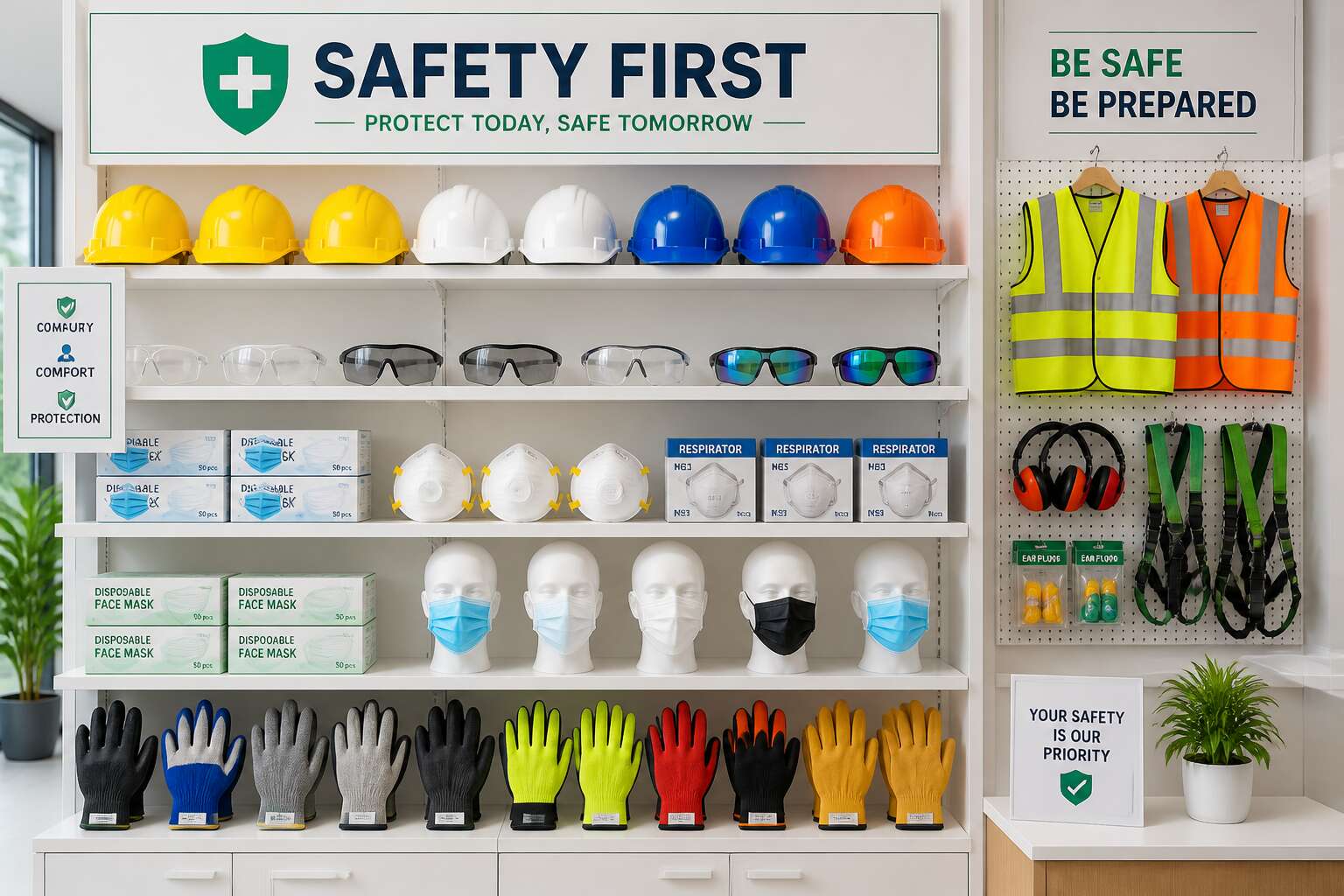
Understanding Personal Protective Equipment
What Is PPE and Why It Matters
Every year, thousands of South African workers suffer injuries that a few centimetres of plastic or fabric could prevent. I have seen how a simple pair of gloves changes a day.
Personal protective equipment, or PPE, is any gear you wear to reduce exposure to hazards. It includes helmets, gloves, goggles, and respirators. Each item serves a distinct role. A hard hat on a site absorbs impact from falling tools. A respirator filters dust that damages lungs. Why does this matter? Because compliance with safety laws is not optional.
When you step into a ppe shop, you need more than a rack of products. You need advice that matches your workplace. A reliable supplier will ask about your tasks, your environment, and your risks. Consider your typical exposures:
- Flying particles that hit your eyes
- Loud noise that degrades hearing
- Chemicals that burn skin
If the gear does not fit properly, it offers false confidence. Understanding PPE means treating it as your final protective measure, not a formality.
Common Types of PPE for Different Industries
Every trade leaves its signature on the worker. After twenty years underground, a miner’s lungs carry a weight no X-ray can show. The right protection rewrites that ending. Inside a ppe shop, sections divide by threat: respirators for airborne particles, visors for flying debris, ear defenders for roaring machinery, and chemical suits for splashes that burn through denim.
- Construction: hard hats, steel-toe boots, high-visibility vests
- Chemical handling: nitrile gloves, face shields, acid-resistant aprons
- Healthcare: surgical masks, gowns, puncture-proof gloves
I have watched a worker pick a disposable mask for a paint booth, then learn that the solvent requires a cartridge respirator. That moment reveals the gap between gear and safety. The correct type is not a preference. It is a calculation of your specific environment. A reliable ppe shop asks about your tasks first. Then they match the barrier to the hazard, not the price tag.
Key Differences Between Disposable and Reusable PPE
Two harnesses hang side by side in a workshop, both rated for the same height. One shows chalky webbing from a hundred descents. The other carries a factory crease. Most workers reach for the one that looks tougher. That instinct misses the real question: which one will protect correctly after this shift.
Disposable gear suits single exposures: dust, splashes, minor particulates. Reusable equipment demands maintenance schedules, seal checks, and storage discipline. A ppe shop will ask about decontamination protocols before recommending either.
Consider the practical differences:
- Disposable respirators are discarded after one use or when clogged.
- Reusable masks require filter replacement, cleaning, and fit testing.
- Disposable coveralls block light contamination; reusable suits depend on chemical resistance ratings.
The correct choice relies on the contamination load and the worker’s capacity for upkeep. A ppe shop stocks both, but only the buyer knows the cleaning routine.
How to Identify Certified PPE Equipment
Certification marks are quiet things. They sit printed on a label, one among many, until the moment they matter. In South Africa, SABS approval and SANS compliance anchor legitimate protective equipment. A harness with a faded stamp, a respirator without a traceable lot number, these are spectral presences on any worksite.
To identify certified PPE, read the packaging as if lives depend on it. A ppe shop that respects certification will let you inspect every marking before purchase.
- Check for the SABS mark and the specific SANS standard number.
- Look for the manufacturer’s name and batch traceability.
- Confirm the equipment matches the hazard rating for your task.
When the label speaks in abbreviations you cannot decode, walk away. Certification is not a sticker. It is a promise, documented and testable.
How to Choose the Right PPE Supplier
Evaluating Product Range and Specialization
A single incorrect glove can halt an entire shift. That is why the ppe shop you choose matters more than its shelf stock. Evaluating product range means checking for depth in specific categories, not just dozens of brands. Specialization reveals itself in how a supplier handles niche items like arc flash gear or chemical aprons. I have seen suppliers who list every item yet cannot answer basic questions about material compatibility. That gap is a red flag.
When assessing a ppe shop, consider:
– Whether they stock regional standards like SANS approved equipment
– Their ability to source low volume specialty items
– Documentation accuracy for audits
A supplier with genuine specialization will offer substitution options when a product is unavailable. They also maintain dual stock for high demand and rare sizes. Range without expertise is just a catalogue. Expertise without range forces costly delays.
Checking Compliance with Safety Standards
In South Africa, the difference between a compliant and non compliant safety item often shows up only after an incident. A ppe shop can display all the right logos, but compliance lives in the paperwork behind each product. Before placing an order, ask for the certificate of conformance and the test report. Check that the standards referenced are current SANS standards, not outdated versions. Verify the batch number on the certificate matches the batch number on the packaging. One mismatch means the item cannot be trusted on site. Consider these checks:
– Confirm the supplier’s accreditation with the relevant body
– Request the original test certificate, not a photocopy
– Check the date of issue and the validity period
– Ask whether the supplier performs incoming inspections
A reliable ppe shop will provide these documents without hesitation. If the supplier hesitates or offers excuses, treat it as a warning. Compliance is not a sales point; it is a legal requirement. The right supplier treats documentation as part of the product, not an afterthought.
Comparing Bulk Pricing and Wholesale Options
In South Africa, volume discounts on safety gear can reduce per-unit costs by as much as 25%, yet the real cost sits in contractual details. When comparing bulk pricing and wholesale options, look past the price per item. A supplier may offer tempting rates, but those rates often shift with delivery schedules or batch sizes.
Consider these variables:
- Minimum order quantities and their effect on cash flow
- Consistency of batch numbers across multiple orders
- Return policies for defective or expired stock
Two suppliers might quote the same rand amount, but one delivers within a week while the other holds stock for a month. The latter pushes the risk onto your project. Wholesale contracts should lock in both price and delivery dates. A reliable ppe shop will itemise every cost, from freight to certification rechecks. That transparency matters more than the deepest discount.
Assessing Delivery Speed and Stock Availability
In South Africa, a shipment that arrives two weeks late costs more than the freight. A supplier’s promise of ready stock means little when the warehouse cannot fill your order. Delivery speed is a matter of site productivity, not convenience.
When evaluating a ppe shop, ask about dispatch schedules and buffer stock. Some suppliers keep safety helmets and reflective vests for large orders. Others order from a factory only after payment, which stretches lead times past a month. Consider these factors:
- Order processing time from purchase order to dispatch
- Frequency of stock counts and reorder triggers
- Backorder history for core items like gloves and masks
Stock availability depends on how a supplier manages seasonal demand. A reliable ppe shop keeps a buffer for unplanned spikes, such as a mining inspection or municipal tender. If they cannot guarantee delivery dates in writing, the cost of a delayed batch can exceed any saved margin.
Navigating an Online PPE Store
Finding Detailed Product Specifications
Most people scroll past the specification sheet. That is a mistake. The spec sheet carries the real information: material weight, breaking strength, and exact dimensions. Photographs flatter a product, but the numbers do not lie.
When I navigate an online ppe shop, I go straight to the technical details tab. If it is missing, I leave. South African workers in mining and construction depend on these figures. A glove with 0.4 millimetre thickness performs differently from one at 0.8. The difference is safety, not preference.
Specifics worth checking:
- Material composition and thread density
- Exact centimetre measurements in size charts
- Water or chemical resistance ratings
The best stores print these plainly on the product page. Hidden details make it harder to trust.
Using Size Charts and Fit Guides
Two centimetres of error in glove sizing changes dexterity in a way that no marketing photo ever will. When I browse a ppe shop, I start with size charts before anything else. Fit guides exist for a reason, and in South African workplaces, a loose strap or tight seam becomes a hazard after eight hours.
Here is what I look for in a size chart:
– Hand circumference measured at the widest point
– Finger length from webbing to tip
– Wrist or ankle dimensions for sleeves and boots
– A tolerance range for each size
The best online stores show these numbers in both millimetres and inches, with a note on how to measure yourself. I have returned gear that matched the label but not my hands. A ppe shop that publishes honest fit guides saves me that trouble. Size charts are not a suggestion. They are a safety calculation.
Verifying Return and Exchange Policies
Return policies reveal how a ppe shop treats its customers after the payment clears. I have learned to read them before I add anything to my cart. PPE is personal equipment. A helmet that does not fit your head or a visor with a hairline crack cannot be fixed by a discount code.
In South Africa, the Consumer Protection Act gives you certain rights, but the shop’s own policy determines how smoothly a return actually goes. I look for these details:
- An inspection period that matches your delivery window
- Clear conditions for opened versus unopened packaging
- Who pays for return shipping
- Whether exchanges get priority over refunds
A ppe shop with a vague policy makes me nervous. If they cannot state their terms plainly, I assume the process will be slow and move on.
Secure Payment Methods and Customer Support
When I navigate an online ppe shop, the payment gateway reveals more than the final price. A dependable store in South Africa offers payment options with verifiable transaction protections, from instant payment notifications to secure redirects. Ambiguity at checkout signals weak backend systems, which later complicates order tracking and customer support.
- Bank-level encryption on every transaction page
- Clear confirmation codes after payment completes
- Support agents who know the payment process without transferring you
Customer support matters as much as payment security. I have dialled helplines that rang endlessly. The best stores respond within hours and speak in concrete terms about stock and delivery. A failed payment handled with speed and clarity restores my trust; a slow response does the opposite.
Shipping Considerations for Hazardous Materials
Shipping PPE with hazardous materials is a puzzle most buyers ignore until a parcel stalls. In South Africa, couriers treat items like certain disinfectants, fuel cell respirators, or chemical gloves under strict dangerous goods rules. A missing safety data sheet can ground a consignment at Johannesburg’s cargo hub for weeks. I watched this happen once. The order was complete, the payment cleared, but the shipment sat because classification paperwork did not match the product.
A dependable ppe shop will address these realities before checkout. They should confirm which carriers accept hazardous loads and whether insurance covers any chemical exposure in transit.
1. Ask if the ppe shop provides hazard declarations with every order.
2. Verify they use couriers licensed for dangerous goods routes.
3. Confirm that packaging meets SANS standards for impact and leak resistance.
Without these steps, a simple purchase turns into a customs exercise. Choose a ppe shop that treats shipping as part of the safety promise, not an afterthought.
Essential PPE Inventory for Small Businesses
Head, Eye, and Face Protection
Head injuries account for nearly a fifth of workplace incidents in South Africa. I have seen workshops where a single hard hat serves every task, from grinding to welding. That is risky. A proper ppe shop supplies equipment for specific hazards. For head protection, consider pressure-absorbing helmets with adjustable suspension. For eye and face safety, you need more than basic eyewear.
- Safety helmets with chin straps for high-risk zones
- Impact-resistant goggles for debris and chemical splashes
- Face shields for grinding and cutting operations
- Welding helmets with proper shade lenses
Small businesses overlook fit and comfort. A worker who sheds an uncomfortable helmet is exposed. Stocking a range of sizes and adjustable models ensures compliance. The right inventory from a trustworthy ppe shop reduces injuries without breaking your budget.
Respiratory Protection and Filtering Facepieces
Respiratory hazards often go unnoticed until symptoms appear. In South African workshops, grinding dust, paint fumes, and welding gases accumulate in enclosed spaces. A filtering facepiece may look simple, but its filtration rating determines whether your team is truly protected.
When selecting respiratory protection from a ppe shop, consider the specific contaminants present. Dust masks are not respirators. Filtering facepieces classified as FFP2 or FFP3 offer measurable protection against fine particulates. For solvents or isocyanates, you need chemical cartridges in addition to particulate filters.
Here is a breakdown of what to stock:
- FFP2 disposable masks for general grinding and sanding
- FFP3 masks for silica dust and asbestos abatement
- Half-mask respirators with replaceable cartridges for paint shops
- Full-face respirators when eye protection is also required
Fit testing is often overlooked by small businesses. A respirator that leaks around the cheekbone provides no protection. A reliable ppe shop offers fit testing services and guides buyers through the process.
Hand and Skin Protection Solutions
Your team’s hands are not optional accessories. In South African workshops, hand injuries steal countless production hours. A decent ppe shop stocks more than one glove type, because one glove cannot handle every task. Consider what belongs in your inventory:
- Nitrile gloves for oils and solvents
- Leather palmed gloves for rough or abrasive materials
- Butyl or neoprene gloves for chemical handling
Skin protection extends past the fingertips. Barrier creams guard against irritants, while moisturising creams repair skin after repeated washing. Stock both. Gloves fail when they fit poorly. A size too small tears, a size too large slips. Buy from a supplier that provides sizing charts and samples. Your workers will thank you, and so will your first aid kit.
Foot and Leg Protective Gear
A dropped pallet can fracture a metatarsal in milliseconds. South African small businesses often overlook foot and leg protection until the first compo claim! A reliable ppe shop should provide solutions for both impact and penetration hazards.
Essential items for your inventory:
- Steel toe boots for general workshop areas
- Metatarsal guards for heavy lifting and stacking
- Knee pads for installation and maintenance tasks
- Cut resistant leg chaps for chainsaw or sharp metal work
Selecting the right fit matters as much as the certified protection level. Proper sizing guides reduce the risk of workers discarding uncomfortable equipment.
High-Visibility and Fall Protection Equipment
In the half light of a loading bay at 5 a.m., a forklift operator relies on the glow of a hi-vis vest to distinguish a pedestrian from the shadows. South African small businesses face the quiet menace of low visibility and gravity alike. The right ppe shop stocks more than hard hats and gloves; it supplies luminance and restraint.
High-visibility gear must meet EN ISO 20471 standards. Look for retroreflective tape that catches headlights, not just bright fabric. For fall protection, anchor points and lanyards demand inspection before every use. A ppe shop should offer harnesses with adjustable leg loops and energy absorbers rated for the user’s mass.
Critical inventory for these hazards:
- Class 2 and Class 3 hi-vis vests and jackets
- Full body harnesses with double lanyards
- Retractable lifelines for work at height
- Rail systems for fixed ladder access
Workers discard ill fitting harnesses faster than a dull blade. Sizing guides and demo units reduce that risk. A fall arrest system only functions if the wearer actually clips in. The ppe shop supplies the tools; the worker provides the discipline.
Storage and Maintenance Best Practices
South African small businesses often discover their ppe shop purchases fail too soon. The cause is neglect, not poor quality. A working inventory requires more than a shelf of items. It demands rotation.
Store respirators in sealed containers away from solvents. Hang fall protection harnesses on padded hangers to prevent creases in the webbing. Assign a dedicated inspection day each month. Mark every item with its purchase date!
- Keep three spare pairs of gloves per worker
- Replace any head protection after a hard impact
- Discard harnesses showing frayed stitches
Maintenance habits extend the lifespan of everything you buy. Wash hi-vis gear with mild detergent. Never dry it in direct sun. The ppe shop gives you the tools; your routine preserves them.
Staying Compliant and Updating Your PPE Stock
Understanding OSHA and ANSI Requirements
“OSHA fines for PPE violations can exceed R180,000 per incident, which is roughly the cost of a very nice bakkie or a year’s supply of industrial-grade safety boots.”
The paperwork portion of PPE management receives the same enthusiasm as a Monday morning meeting, yet it remains critical. A ppe shop that fails to document equipment inspections is setting itself up for regulatory trouble. The audit trail matters more than the price tag. SABS approval remains the gold standard in South Africa, while ANSI and OSHA guidelines provide the international baseline that multinational clients expect.
Updating your stock demands more than replacing worn items. It requires reviewing changes in workplace hazard assessments. When your operations shift, your protective equipment must shift with them.
– Review incident reports to identify recurring equipment failures
– Check manufacturer recalls and safety alerts
– Verify that replacement parts match original specifications
– Update training materials when equipment standards change
The gap between having PPE and having compliant PPE often comes down to what you cannot see. Labels fade, materials degrade, and older stock may no longer meet the latest standards. A proper ppe shop routine includes quarterly audits and documentation that can withstand an inspector’s scrutiny. The quiet satisfaction of passing an unannounced compliance check rivals the relief of finishing year-end tax returns.
Compliance changes when the supplier changes. Certificates of conformance, batch numbers, and test reports accumulate like office clutter. Track them properly. The difference between “we ordered from a cheap supplier” and “we have the documentation to prove full compliance” represents the entire argument during a site visit. Without documentation, even the best maintained equipment becomes suspect in the eyes of an inspector. Smart operators treat their compliance files as seriously as their stock inventory. Keeping both current ensures that when the safety officer arrives, the only surprise comes from how well prepared you are. Nobody wants to explain a lapsed certification while standing next to a worker wearing outdated equipment. That conversation ends one way only.
Regular Safety Audits and Equipment Inspections
The quiet dread of a compliance audit often outweighs the actual inspection itself. Yet for a ppe shop, the physical stock check and the paper trail are inseparable twins. Passing that unannounced visit means proving that every pair of gloves or safety boot in your supply chain meets SABS approval and matches the current hazard assessment, not the one from three years ago. Replacing worn items from a ppe shop is the easy part. The layered work lies in assigning the correct PPE to the recorded task and ensuring the documentation reflects that swap.
A rigorous audit routine works best with a visible schedule.
- Rotate stock based on manufacturing dates to prevent material degradation before a big order
- Pull samples from the same batch to verify they match the original specifications
- Cross-reference the batch numbers against manufacturer recalls and safety alerts
- Review incident reports to spot recurring equipment failures before a serious event
Without those steps, an inspector could question whether you are selling compliant PPE or just an empty promise. The discipline of rotating stock directly influences which items stay on the shelf and which get flagged for disposal.
Auditing also forces a review of a shifting supplier landscape. When the supplier changes, so do the certificates of conformance, batch numbers, and test reports. A ppe shop must track those documents with the same seriousness it gives its inventory. Keeping both current means the audit trail stays intact, and when the safety officer walks the floor, you are not left standing next to a worker wearing outdated gear. That is the difference between a quiet morning and an expensive conversation.
Training Staff on Proper PPE Usage
Training is the silent audit. It happens on every shift, without an inspector in sight. A ppe shop can supply certified helmets and boots, but the gear only protects when worn correctly.
Update your stock and your training at the same time. When a new batch of gloves arrives, schedule a short hands-on session. Workers must inspect the material before first use and understand why an old pair fails.
Keep an attendance register for every session. Note the equipment covered and the procedure demonstrated.
1. Show the correct donning method.
2. Let the worker adjust the fit.
3. Check the seal or strap tension.
4. Record the session details.
South African safety inspectors expect this paper trail. The gear from a ppe shop must match the documented skill of the people wearing it.
Tracking Expiration Dates and Reordering Strategies
Expired gloves or degraded respirators slip into daily work without notice. That is why tracking expiration dates is not a clerical chore, it is a compliance act. Every batch from a ppe shop carries a shelf life, and your register should mirror that timeline.
Set a monthly stock review. Check seals, packaging, and manufacturing dates. When items near their end, flag them for reorder. Keep a buffer for urgent replacements.
- Record the expiration date on the storage bin
- Reorder at 20% remaining stock
- Rotate older items to the front
Reordering from the same ppe shop simplifies this process. Their records align with your audit trail, ensuring inspectors see consistent, current gear. I have found that a simple spreadsheet beats guesswork every time.
Emerging Trends in Smart PPE Technology
Let’s be honest, compliance audits are where good intentions go to die, usually because someone is wearing a hard hat from the last decade. Staying compliant is about making sure your gear actually works when the inspector walks the floor. Regular audits force you to check the condition of every harness and visor. You need a system, not a prayer. Our team prefers a monthly schedule that includes checking the integrity of every seal. When you do this, a reliable ppe shop becomes your ally, ensuring that the replacements you order match the exact specifications you already verified.
Consider these steps for a tighter workflow:
1. Verify the certification labels on every new shipment.
2. Test moving parts on any adjustable equipment.
3. Review incident reports to see if gear contributed to the risk.
The next phase of protection is looking at emerging trends in smart PPE technology. These innovations are moving beyond simple barriers. Imagine sensors that alert you when a worker’s core temperature rises to dangerous levels or gloves that communicate wear and tear before a puncture occurs. This data feeds directly into your stock updates, changing how you order from your ppe shop. Instead of guessing quantities, you rely on usage data to maintain precise inventory. The future of safety gear is active, and it rewrites the rules of the game for stock management and worker protection.




0 Comments