Passive Safety Systems
Seatbelts and Pretensioners
No piece of safety equipment in a car is more vital than the seatbelt. It works without a sound, but modern pretensioners take that duty further. These devices use a pyrotechnic charge to pull the belt tight against your body in the instant before a crash.
The pretensioner removes the slack that would otherwise allow your chest to lurch forward. It locks the spool and anchors you to your seat. Here is what a pretensioner setup typically includes:
- A deceleration sensor
- A pyrotechnic igniter
- A locking spool
This mechanism protects your spine and internal organs from the violent stop. For South African drivers navigating tough roads, this silent system offers critical protection, and I have seen it preserve lives on the highway!
Airbags and Their Deployment Zones
Airbags deploy at up to 320 km/h, a speed that makes you flinch before the bag even touches you. That explosive cushioning is a crucial piece of safety equipment in a car, ready to intervene when your braking math fails. Deployment zones are mapped with precision, and knowing them matters.
Front airbags handle head-on collisions, catching your skull and chest as they lunge forward. Side airbags deploy from your seat or door to protect your torso when a bakkie crosses the line. Curtain airbags drop from above to keep your head off the window glass during a rollover.
The zones in short:
- Front: head and chest
- Side: ribs and pelvis
- Curtain: head and neck
Sensor logic prevents accidental inflation, a relief when you hit a pothole on the N1 and the whole car emits a sound you refuse to identify.
Crumple Zones and Energy Absorption
At the instant of impact, the chassis becomes a choreographer of controlled collapse. Crumple zones are the car’s promise to sacrifice bodywork for your skeleton, folding in precise geometric patterns that siphon kinetic energy away from the cabin. On South African roads, where a pothole can steer you into an unforgiving barrier, this metamorphosis of metal is quiet artistry.
Energy absorption transforms violent motion into heat, sound, and structural deformation, a process that shaves precious milliseconds off the deceleration curve. The passenger cell remains stubbornly rigid, a sanctuary carved from physics. Consider what this safety equipment in a car does beyond the visible:
- It redirects crash forces along predetermined paths.
- It lengthens the stopping distance for your body.
- It prevents the steering column from intruding into your chest.
Your seatbelt, airbags, and this crumpling shell work as one quiet agreement. The body crumples; you do not. That is the strange mercy engineered into every modern vehicle, a bargain struck between steel and your own fragile momentum.
Head Restraints and Whiplash Protection
Most drivers sit with their head restraints too low and too far back. That misadjustment explains why whiplash remains a common injury in rear-end collisions. This piece of safety equipment in a car works only when positioned directly behind your head.
In a crash, your body is pushed into the seat while your head lags behind. The restraint catches that motion, stopping the neck from hyperextending. To make it work:
- Raise the restraint until its top aligns with the top of your skull.
- Reduce the gap between the back of your head and the restraint to a few centimetres.
- Lock the restraint so it does not move during impact.
The mechanism relies on geometry, not strength. A head restraint placed right protects the cervical spine better than any cushioning foam. This component demands your attention before the journey, not during it.
Active Safety Technologies
Anti-lock Braking Systems
Anti-lock Braking Systems prevent your wheels from locking up when you brake hard, a feature that matters deeply on South African roads. A sudden pothole or a minibus taxi pulling across three lanes will trigger your panic reflex, and ABS gives you a chance to steer while slowing down.
When you slam the brakes, the system pulses brake pressure many times per second, allowing the tyres to maintain grip with the road. You feel this as a rapid vibration through the pedal. That sensation means the system is doing its job, not that your car is falling apart.
- Prevents wheel lockup on wet or gravel surfaces
- Maintains steering control during emergency braking
- Helps reduce stopping distances in low-grip conditions
ABS should sit high on your list of safety equipment in a car, especially for drivers who frequently travel on rural routes or during summer thunderstorms.
Electronic Stability Control
Some drivers believe their reflexes are enough. The physics of a sudden weight shift on a wet tar road disagrees. Electronic Stability Control is the quiet correction before your panic reaches your foot. It reads your steering input against the car’s actual yaw, then applies brake force to individual wheels to pull the vehicle back onto your intended path.
On a Gauteng highway after a thunderstorm, or a gravel pass in the Cape, ESC acts faster than any human. It supplements your sensory limits without asking permission. In real time:
- Detects loss of traction during oversteer or understeer
- Applies targeted braking to individual wheels
- Reduces engine torque to stabilize the vehicle
These interventions make ESC an essential part of the safety equipment in a car. Without it, a slight overcorrection becomes a spin that physics will not forgive.
Traction Control Systems
You press the accelerator on a slick M1 after Highveld rain, and the drive wheels lose traction. Traction Control Systems recognize that loss of forward grip before you feel it. It is a specialized component of the safety equipment in a car. Unlike anti-lock brakes, which regulate wheel speed during braking, traction control manages wheel speed during acceleration.
It compares the rotational speeds of the wheels. If one turns faster than the others, the system steps in. The intervention can take several forms:
- Reducing engine torque to limit wheel spin
- Applying brake force to the specific slipping wheel
- Adjusting the throttle response for the current surface
These actions restore grip without cutting power abruptly. The intervention happens in milliseconds. On a gravel road in Mpumalanga or a steep driveway in the Cape, this system prevents the rear wheels from digging in and losing directional control. The technology ensures the car moves forward with usable traction, no matter the surface beneath it.
Crashworthiness and Structural Design
Reinforced Passenger Compartments
Crashworthiness determines whether a vehicle’s cabin survives an impact intact. The reinforced passenger compartment functions as a protective structure, engineered to hold its shape while surrounding materials deform. Ultra-high-strength boron steel in the A-pillars and roof rails resists bending forces that would otherwise crush the survival space.
The floor pan and rocker panels channel crash forces around the cabin rather than through it. Hydroformed cross members distribute energy along predetermined paths. This is essential safety equipment in a car, though most occupants never see it. Alongside visible restraint systems, this hidden framework constitutes the most critical safety equipment in a car.
- Boron steel A-pillars resistant to roof collapse
- Reinforced door sills preventing side intrusion
- Hydroformed rails guiding deformation away from occupants
- Structural adhesives maintaining seam integrity under extreme loads
I once observed a crash test where the vehicle struck a pole at 64 km/h. The front section collapsed completely. Yet the doors opened normally and the cabin retained full headroom. What a demonstration of how far structural engineering has come!
Side-Impact Protection Beams
Roughly a quarter of occupant fatalities in passenger vehicles result from side impacts. A vehicle striking you from the side at 60 km/h delivers energy directly into the door structure, with only thin sheet metal between the occupant and the impact. This is where side-impact protection beams earn their place as essential safety equipment in a car.
These high-strength steel tubes sit horizontally inside each door, converting the door panel into a load-bearing element. When a collision occurs, the beams transfer force to the B-pillars and floor structure, spreading the load across the entire body shell. I have examined door assemblies from T-bone collisions and found the outer panel heavily deformed while the inner beams held firm.
Manufacturers now employ several beam profiles:
- Circular tubes with corrugated ends for controlled folding
- D-shaped sections that resist bending in two axes
- Dual-beam arrangements for taller vehicles
Rollover Protection Systems
Rollovers account for over half of SUV occupant deaths in single-vehicle accidents. The roof structure must withstand a direct hit against tarmac. Roof crush resistance depends on high-strength steel in the A-pillars and B-pillars. I have examined inverted vehicles where the cabin held firm, and the difference was pillar gauge and weld integrity.
- Pillars that transfer loads to the body sills
- Glazing that stays intact to hold occupants inside
- Side curtain airbags that prevent head contact with the ground
These systems work together as safety equipment in a car. The passenger compartment preserves survival space through controlled deformation. Crashworthiness engineering separates a recoverable rollover from a fatal one.
Child Safety Seat Anchors
A child restraint is as trustworthy as the metal it latches into. While energy management focuses on adult occupants, child safety seat anchors demand a different engineering fidelity. Welded deep into the unibody rails, these anchors form the link between a restraint and the survival cell. This is where safety equipment in a car matters most for the smallest passengers.
I have watched a child seat hold firm in crash tests because the ISOFIX latch engaged cleanly. The lower anchors sit at the rear seat bight, while the top tether secures behind the seatback. Together, they resist forward rotation and limit head excursion.
These anchors manage forces at once:
- Forward load from the child’s harness
- Vertical lift that creates slack
- Twisting stress from oblique impacts
Manufacturers weld these mounts into the body structure. An anchor that tears free voids all other protection, turning a survivable crash into tragedy. Unforgiving physics!
Pedestrian Impact Mitigation Features
Pedestrians are part of the crash equation, and they carry no airbag. Modern engineering transforms the bonnet into a controlled impact surface. Active bonnet lifters deploy pyrotechnically when sensors detect a human form, raising the panel to absorb the skull’s kinetic energy.
This safety equipment in a car extends beyond the cabin. The cowl, the windscreen base and the bumper profile all reduce leg fractures and head trauma. Designers place crush boxes behind the bumper, softening blunt force before a body meets the radiator.
- Hood hinge actuators trigger in 30 milliseconds.
- Pedestrian airbags cover the lower windscreen.
- Deformable bumper foams direct impact energy.
One moment a commuter steps off the kerb. The next, systems you never see decide the outcome.
Visibility and Signaling Equipment
Headlight Types and Adaptive Lighting
Headlights do more than light up the road. They are your primary signaling tool when the sun disappears over the Highveld. Yet many drivers treat them as an afterthought, which is odd for a piece of safety equipment in a car that can prevent a collision before it happens.
Halogen bulbs still dominate entry level models, but they struggle in heavy rain. LED headlights offer quicker activation and a crisper beam. Adaptive lighting takes things further by swivelling the beam into corners as you steer. That adjustment matters on tight coastal passes where a fixed beam leaves you guessing.
- Halogen: affordable, familiar, but slow to warm up
- LED: bright, energy efficient, and instant
- Adaptive: pivots with your steering for better visibility
Signaling equipment, from indicators to brake lights, only works if other drivers notice it. DRLs help in daylight, but a dirty lens ruins any advantage. Keep them clean, because visibility is a negotiation between you and everyone else on the N1!
Windshield Wipers and Washer Systems
Rain on the Highveld turns a simple commute into a game of guesswork. Your windscreen wipers and washer systems are the most neglected safety equipment in a car. A worn blade smears water instead of clearing it. A misaligned washer jet leaves you blind.
Windshield wipers handle more than rain. Dust from gravel roads, mud splashes, and insect strikes all demand fluid and a clean edge. The rubber degrades in the sun. The mechanism loosens with use. A quick visual check takes seconds.
Visibility relies on a chain:
- Wiper blades with a smooth, streak-free sweep
- Washer fluid that cuts grime
- Lenses and sensors free of road film
Signaling equipment, from indicators to brake lights, only matters when someone else sees it. A functioning system lets you communicate your next move. In heavy traffic, that communication is everything. The most advanced headlights mean nothing if your windscreen turns the road ahead into a blur.
Side and Rearview Mirror Adjustments
Mirrors reveal the lane changes, the overtaking taxis, and the cyclist in your blind spot. But only if you set them correctly. Most drivers aim for a glimpse of their own car. That is a mistake. The true alignment pushes the view outward, eliminating overlap with the rearview mirror.
For side mirrors, lean your head to the driver’s window and adjust until the car’s flank disappears. Then lean toward the centre console and do the same for the passenger side. This method expands your field of vision and reduces the need to twist in your seat.
- Check mirror glass for cracks or clouding.
- Wipe the lenses when you clean your windscreen.
- Adjust after any driver change.
This neglected practice is part of your safety equipment in a car. Without proper mirror angles, your indicators and brake lights signal to no one, because you never saw the vehicle beside you.
Brake Lights and Emergency Flashers
A single burnt-out bulb can render your braking intentions invisible to the driver behind you. In South Africa, where traffic lights often die during load shedding, your brake lights and emergency flashers are your primary signalling tools. They are fundamental safety equipment in a car, yet most drivers never test them until it is too late. Brake lights demand immediate attention. They communicate deceleration, and they buy you critical metres of following distance. Emergency flashers broadcast your position when stationary, or crawling through an unlit intersection.
Consider what these lights communicate to other road users:
– a sudden stop on the N1
– a breakdown on a blind bend
– a queue for a robot that is not working
Each flash is a warning. Every unlit tail lamp is a risk. Keep the lenses clean. Test all bulbs monthly. A broken switch or a cracked lens turns your vehicle into a hazard for everyone around you. Properly functioning lights are the difference between a near miss and a catastrophe.
Dashboard Warning Lights and Indicators
An illuminated dashboard symbol is a direct message from your vehicle. The oil pressure lamp, the coolant temperature gauge, the battery charge indicator, they each relay a distinct mechanical problem. Ignoring these signals can leave you stranded on a dark road.
Consider what these warnings communicate:
– The red oil canister means lubrication pressure has dropped
– The engine management light signals a fault in the emissions or ignition system
– The tyre pressure monitor detects a slow leak before it becomes a blowout
These indicators form a core part of the safety equipment in a car. They are not decorative. A persistent warning light deserves attention, not a mental note to check later. When the brake pad wear sensor activates, it is asking for intervention before metal grinds against metal. Dashboard awareness is arguably the most direct safety equipment in a car, a constant mechanical conscience.
Horns and Audible Warning Devices
A horn blast travels roughly 110 decibels, a sound that cuts through glass, noise, and a distracted mind. It is a direct line between one road user and another. Many drivers treat it as an annoyance device. In reality, it is an intervention tool with a half-second window to prevent something permanent.
The horn is an overlooked part of the safety equipment in a car. That two second blast at a blind intersection tells an approaching cyclist you are moving. It pulls a pedestrian back from stepping into traffic. It alerts a truck driver who has started to drift into your lane.
Engineers shape the horn’s voice deliberately. A low frequency tone carries further. Dual tone units reach more frequencies of human hearing. It matters. A weak horn is a broken promise.
Emergency and Response Gear
First Aid Kits and Contents
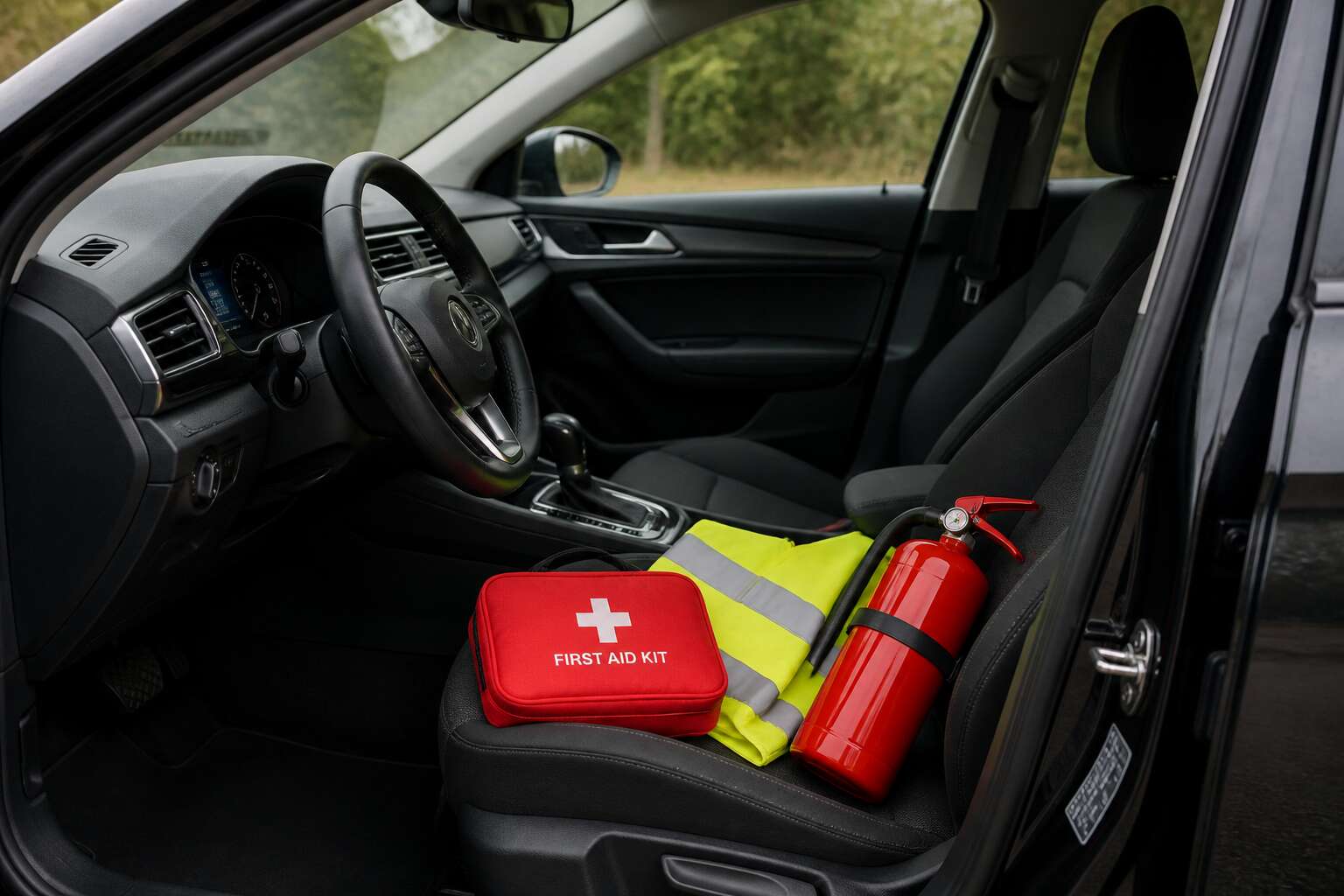
Most drivers treat a first aid kit as an afterthought, yet it is the most direct link between a collision and a recovery. As safety equipment in a car, it deserves the same attention as brakes or airbags.
Standard contents should cover common injuries. Here are the essentials:
- Sterile gauze pads and adhesive bandages
- Antiseptic wipes and antibiotic ointment
- Triangular bandages for slings
- Scissors and tweezers
- Disposable gloves
The presence of these items means little if they are expired or inaccessible. Storage matters! A kit buried under luggage becomes useless. Check expiration dates monthly. Trauma shears cut through clothing quickly.
South African conditions add specific demands. Coastal moisture corrodes equipment, so use waterproof containers. Heat degrades medication, so avoid direct sunlight. A practical kit is not a luxury item. It is a necessary component of responsible driving.
Fire Extinguishers and Ratings
Most drivers ignore the fire extinguisher bolted beneath their seat until smoke curls from the dashboard. That neglect is dangerous, yet this device remains essential safety equipment in a car. South African heat degrades seals, and coastal humidity corrodes valve springs. Inspect the gauge monthly. The rating system deciphers what it can fight:
- Class A: cloth, wood, paper
- Class B: petrol, oil, solvents
- Class C: electrical fires
A 2kg dry chemical unit handles all three. Mount it upright and within reach. I have seen extinguishers buried under cargo, useless in the moment they are called upon.
Reflective Warning Triangles and Vests
A broken down vehicle on the N1 at dusk is a deadly hazard. Reflective warning triangles and vests cost less than a tank of fuel, yet they are often absent from safety equipment in a car. Drivers struggle to see a stationary car without reflective markers. In South Africa, the law requires you to carry a triangle, but compliance remains low.
Wear the vest before you step out. Place the triangle at least 45 metres behind your car. On a bend, place it before the curve so oncoming drivers see it earlier. For a steeper road, increase the distance. This simple kit is essential safety equipment in a car, not a decorative accessory.
- Set the first triangle 2 metres behind the bumper
- Position the second 20 metres further back
- Keep the third triangle 45 metres from the vehicle
Maintenance and Inspection Essentials
Spare Tires and Tire Pressure Monitoring
Few drivers consider how much of their safety equipment in a car depends on four small contact patches. A spare tyre is a critical component that often sits neglected for years. Pressure monitoring systems alert you to slow leaks, yet they cannot force you to react. In South Africa, heat alone can raise tyre pressure by 10 to 15 kPa on a long highway stretch.
Your spare tyre demands its own review, covering:
- Tread depth and sidewall cracks
- Inflation level against the manufacturer rating
- The age of the tyre, even if unused
Your monitoring system also demands attention. Sensor batteries die, and warning lights can lie. A quick monthly glance at the display and a physical pressure test reveal more than any dashboard icon. Without such care, a breakdown on a remote road turns from an inconvenience into a crisis. This overlooked component of safety equipment in a car rarely receives the attention it deserves.
Brake Fluid and System Checks
Brake fluid does silent duty. In a country of long gradients and sudden stops, its condition dictates your stopping distance. Moisture seeps into the system through microscopic pores. That contamination lowers the boiling point, causing vapour locks precisely when you need hard braking. The pedal becomes the message: a firm, high bite suggests health. A spongy, sinking sensation demands attention.
Inspect the reservoir carefully. Look for discolouration, sediment, or a level that drops between services. I always check the hoses for swelling, but a simple monthly list works better:
- Reservoir level between minimum and maximum marks
- Pedal response with the engine running
- Flexible hoses for swelling, cracking, or dampness
- Warning light operation on the dashboard
Each element forms part of the essential safety equipment in a car. Neglect here turns a routine stop into a close call!
Battery Maintenance and Jump-start Equipment
South African summers punish batteries. Heat accelerates internal corrosion, and starting a hot engine after load shedding strains the system. The terminals deserve a monthly glance. I check for a whitish crust on the posts; bicarbonate of soda paste cleans it off. A battery that shifts in its bracket is a hazard; on a gravel road it can short against the bodywork.
For jump-starting, cables are the minimum. A portable booster pack with a charge indicator offers independence, especially at 2 a.m. on a quiet stretch of the N1. Such equipment counts as essential safety equipment in a car. The correct connection order runs positive clamp first, then negative to an unpainted metal surface. Lending cables introduces a social contract; gratitude rarely outlasts the charge.
Properly maintained, these items are unassuming safety equipment in a car. They ask little attention until the moment they become indispensable.
Fluid Leak Detection and Coolant Levels
Fluid leaks announce themselves with colour and smell long before the warning lights arrive. On my own vehicle I inspect the driveway after a long drive. A clean patch of concrete is a good sign. A spreading stain asks for investigation.
Coolant levels deserve particular scrutiny in the Highveld heat. The reservoir should sit between the minimum and maximum marks. A weekly dip suggests a slow leak in the radiator or a weeping water pump. Antifreeze carries a sweet, sharp scent that is hard to miss.
Here is the colour code of trouble:
- Pink or green residue: coolant escaping under pressure.
- Dark, oily patches near the sump: engine oil.
- Reddish smear along the gearbox: transmission fluid.
Each inspection forms part of the safety equipment in a car. A cooling system that fails on a remote Karoo road leaves you stranded with expensive decisions. Vigilance here is quieter than an airbag but no less significant.



0 Comments