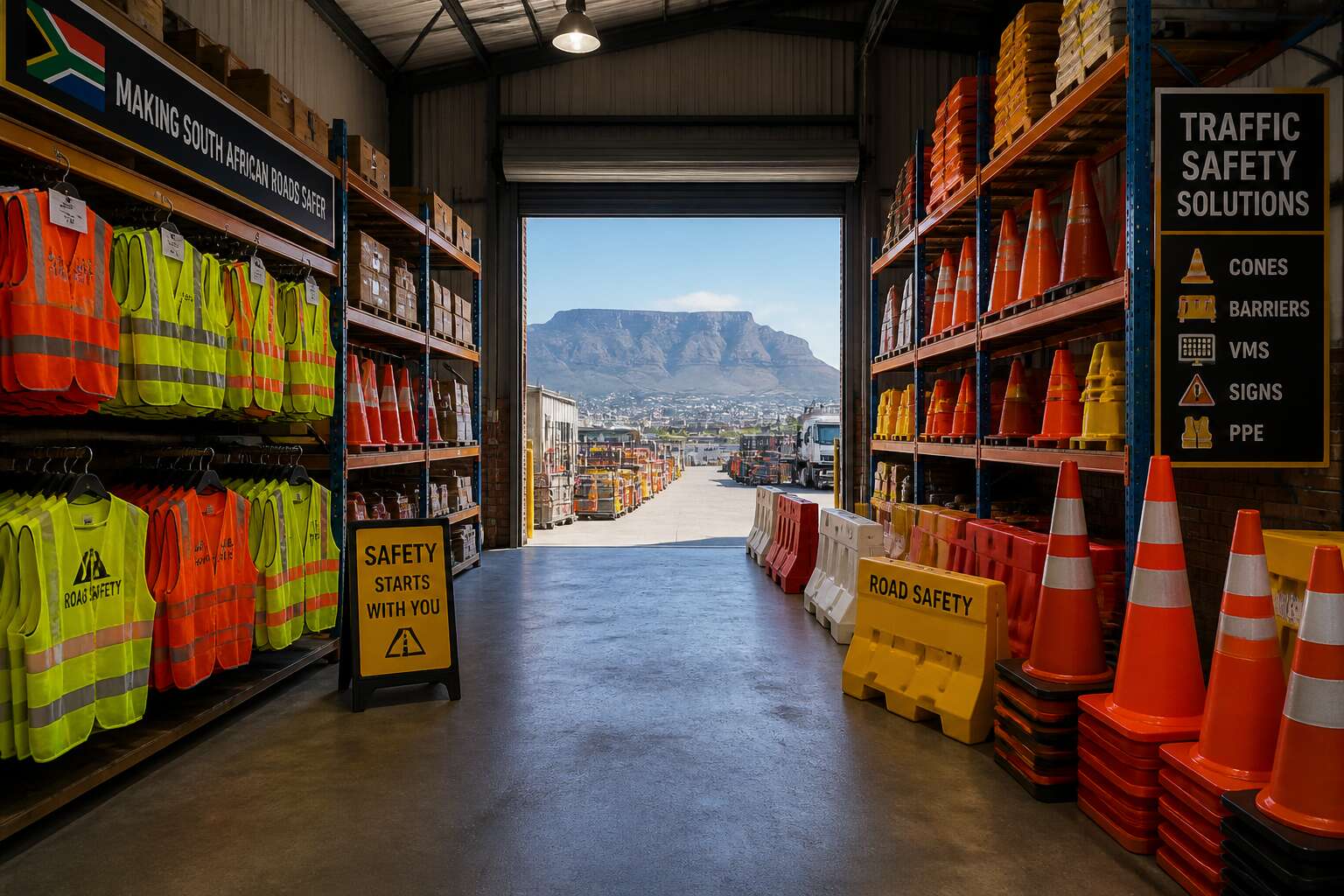
Understanding the Road Safety Landscape
Key Infrastructure Challenges Facing South Africa
South Africa’s road network stretches over 750,000 kilometres, yet a significant portion suffers from decades of underinvestment. The result is a situation where potholes, faded markings, and missing barriers create hazards that demand immediate attention!
- Rural routes lack adequate lighting and reflective signage.
- Urban intersections suffer from malfunctioning traffic signals.
- Highways show worn guardrails and crumbling shoulders.
These infrastructure deficits amplify the burden on road safety equipment suppliers south africa. I’ve seen how they must deliver durable, high visibility solutions that withstand harsh weather and heavy traffic. Without reliable equipment, even the best maintenance plans fall short.
Who Regulates Road Safety Equipment Standards?
Regulation shapes every cone, barrier and reflector installed on South African roads. The South African Bureau of Standards (SABS) publishes the technical specifications, while the Road Traffic Management Corporation (RTMC) enforces compliance across provinces. The National Regulator for Compulsory Specifications (NRCS) also requires letters of authority for imported safety equipment, and failing to secure one halts delivery at the port!
I have watched valid projects stall when certification lapses. A single missing SABS mark can delay entire installations, which is why reputable road safety equipment suppliers south africa treat compliance as their first deliverable. The regulatory framework is not optional overhead; it determines whether the work earns trust.
- SABS approved testing for retroreflective materials
- NRCS letters of authority for imported goods
- SANRAL technical requirements for national routes
Each standard governs how products perform under real conditions. A barrier that fails an audit fails the public too, and no tender survives that outcome.
Why Upgrading Safety Equipment Is a National Priority
Every fatality on a South African road traces back to a decision before the crash. Substandard barriers, faded reflectors or worn signage mean accepting preventable deaths. Upgrading safety equipment is not about optics. It decides whether the physical environment protects road users or exposes them.
The national priority is clear. Road crash costs run into billions, and the heaviest burden falls on pedestrians and minibus taxi passengers. When municipalities procure from road safety equipment suppliers south africa, they choose measurable outcomes. Reliable road safety equipment suppliers south africa know that material quality determines whether a barrier saves a life or becomes debris. I have seen that difference on site!
Proper equipment achieves:
- Retroreflective sheeting that performs after years of UV exposure
- Crash cushions that absorb energy rather than transferring it
- Guardrails that direct vehicles away from dangerous obstacles
The gap between these products and cheap substitutes is measured in lives.
Core Equipment Categories You Need to Know
Traffic Signage and Visual Guidance Systems
On a dark N1 stretch, a single faded warning sign can cost lives. The difference often lies in the materials and the precision of the visual guidance systems supplied by road safety equipment suppliers south africa. High grade retroreflective sheeting performs differently under wet conditions and heavy vehicle glare, so specifications matter far more than shelf price.
Core signage categories include regulatory signs, warning signs, and information boards. Visual guidance extends beyond static boards:
- Delineators and raised pavement markers for lane discipline
- Variable message signs for real time hazard alerts
- Chevron alignment markers for sharp curves
We rarely notice good signage until it is missing. The engineering behind these systems determines whether a driver reacts in time or discovers the hazard too late. That is why experienced road safety equipment suppliers south africa prioritise certified materials over convenience.
Crash Attenuators and Guardrail Systems
A guardrail can prevent a 30 metre drop from becoming a fatality, but only if it is engineered for that specific site. Crash attenuators absorb kinetic energy, allowing a vehicle to decelerate safely instead of hitting a rigid object. Road safety equipment suppliers south africa stock these systems with varying impact ratings and installation footprints.
Common categories include:
- End terminals for guardrail transitions
- Water filled barriers for temporary works
- Reusable crash cushions for high frequency impact zones
The critical detail is matching the attenuator’s test level to the approach speed and the available clearance. I have seen cheap substitutes fail under moderate loads because they were designed for parking lots, not highways. Reliable road safety equipment suppliers south africa provide documentation for each unit, including material certifications and installation guidelines. Without that traceability, a safety device becomes a liability.
Road Marking Materials and Application Machinery
A single stripe of reflective thermoplastic can change a driver’s fate on a dark N1 stretch. Road markings are the quietest safety device on any highway, yet they demand precise material selection and calibrated machinery to perform correctly.
Road safety equipment suppliers south africa offer more than paint buckets. They supply durable thermoplastic that bonds to asphalt in extreme heat, preformed tape for immediate adhesion, and cold applied paint for temporary zones. Application equipment matters equally. Truck mounted stripers lay lines with millimetre accuracy, while handheld applicators handle pedestrian crossings and symbols.
Consider the material options:
– Thermoplastic: long lasting, highly reflective, suited for high traffic roads
– Cold applied paint: fast drying, cost effective for maintenance work
– Preformed tape: instant application, ideal for temporary lane changes
Choosing the wrong binder creates skips, bubbles, and faded lines that fail at night. Reputable road safety equipment suppliers south africa test every batch and calibrate machinery for local conditions.
Temporary Traffic Control Devices for Work Zones
Work zones are the most transient hazards on South African roads. A closed lane without proper delineation invites chaos. Temporary traffic control devices bridge the gap between permanent infrastructure and shifting construction realities. Road safety equipment suppliers south africa stock a range of portable systems designed for rapid deployment and removal.
Key categories include:
- Plastic water filled barriers that absorb impact and resist wind displacement
- Portable rumble strips that alert drivers to lane shifts
- Temporary signage mounted on skids or trailers
- Arrow boards that direct merging traffic
The choice of device depends on the duration of the work and the speed of approaching traffic. I have watched crews underestimate how much time drivers need to react to a lane shift. A short term maintenance job requires simpler solutions than a multi month freeway upgrade. Suppliers who understand local conditions recommend devices that meet South African standards.
High-Visibility Apparel and Worker Protection Gear
High visibility apparel separates a worker from the roadside scenery. I have watched crews in Johannesburg where the vests faded to a shade indistinguishable from the concrete behind them. These garments have one assignment: catch the eye of a driver who would rather glance at a phone.
Road safety equipment suppliers south africa treat fabric as a life saving property. The Highveld sun bleaches inferior material within months.
- Class 2 reflective vests with SANS approved tape
- Hard hats with chin straps that stay attached
- Steel capped boots with puncture resistant soles
- Gloves that allow dexterity without sacrificing grip
The reflective tape must survive washing and weather. A worker two metres from a truck at highway speed deserves every advantage. Visibility is the quiet courtesy we owe those who labour close to moving traffic!
How to Assess Supplier Reliability and Compliance
Navigating SANS, SABS, and AIA Accreditation
A certification sticker means little if the supplier behind it cannot prove their work. Road safety equipment suppliers south africa operate under SANS standards, but verifying compliance requires more than a glance at a logo.
When assessing any candidate, request their SABS certification documents and verify the certificate number directly with the accreditation body. Reliable suppliers share this information without hesitation. They also explain how their products are tested against SANS specifications. AIA accreditation adds another layer of scrutiny, confirming that an independent body has audited their manufacturing processes.
Red flags include:
- Vague answers about certification scope
- Reluctance to provide documentation
- Products lacking traceable batch numbers
Suppliers who cannot articulate their compliance path are usually hiding something. In my experience, road safety equipment suppliers south africa who go quiet during due diligence are rarely worth the risk.
Materials Testing and Certification Requirements
Reliability in the road safety equipment suppliers south africa market often boils down to how they treat a single batch of asphalt or reflective sheeting. Ask to see their internal quality control logs, past the glossy certificate. A supplier who cannot produce raw material test reports for the last delivery is a supplier who hopes you never ask.
Certification requirements vary by product, but the baseline is consistent. Every supplier should trace each unit to a specific test date and operator. When I audit a candidate, I look for:
- Calibration records for their testing equipment.
- A documented process for non-conforming materials.
- Third party lab results for every production run.
A supplier who volunteers these documents without a court order is worth your time. The rest are selling paint and prayers.
Durability, Weather Resistance, and Lifecycle Costs
The South African sun does not negotiate. UV exposure, summer downpours, and heavy freight traffic test every component on our roads. The real question for road safety equipment suppliers south africa is whether their products survive year three of constant exposure. Reliability shows in warranty claims. A supplier with low returns and clear field data has done the hard work. Look for evidence of accelerated weathering tests matched to local conditions, not overseas data sheets.
When comparing costs, consider the full lifecycle:
– Purchase price
– Expected service life under South African conditions
– Replacement labour and traffic disruption costs
The cheapest reflective sign often fails first, and the price of failure includes crashes. Ask road safety equipment suppliers south africa for their warranty claim rate and their oldest installations still in service. A supplier who quotes total cost of ownership, rather than just unit price, understands the market.
Procurement and Logistics for Local Projects
Working Within Municipal Tender Frameworks
Municipal tender frameworks demand more than a competitive price. They require suppliers to demonstrate logistical capacity across provinces, from manufacturing lead times to delivery schedules that align with maintenance calendars. For road safety equipment suppliers south africa, this often means coordinating with multiple depots while ensuring SABS certified products arrive on site exactly when crews are ready.
Procurement cycles rarely forgive delays. A missed delivery window can stall an entire roadworks project, which is why many suppliers now hold buffer stock locally. One tender we handled required weekly deliveries to three different districts, each with its own acceptance criteria. That kind of flexibility separates reliable partners from the rest. Common logistical hurdles include:
- Transport permits for oversized loads like guardrail sections
- Site access windows restricted to off peak hours
- Municipal inspection sign offs before installation crews mobilize
Lead Times, Volume Discounts, and Bulk Pricing
For many contractors, procurement timing decides profit margins. Local projects rarely enjoy the luxury of long planning cycles. When a municipality approves emergency repairs, materials must move within days, not months. Road safety equipment suppliers south africa who maintain pre positioned stock understand this rhythm. Their lead times shrink from six weeks to seventy two hours, which changes how crews schedule their work.
Volume discounts appear when buyers consolidate orders across multiple project phases. I have watched procurement managers save nearly a third on guardrail by planning for the full financial year instead of ordering one intersection at a time. That approach unlocks bulk pricing and reduces transport costs per unit.
A few realities temper those savings:
– Remote site access adds travel days
– Custom sign fabrication bypasses standard stock
– Seasonal demand spikes stretch production queues
Bulk pricing assumes a stable schedule. When delivery windows slip, storage costs and weather exposure quietly eat into the discount.
After-Sales Maintenance and Spare Parts Availability
The cheapest quote is rarely the cheapest contract. Procurement and logistics for local projects depend on how well a supplier understands municipal workflows. Road safety equipment suppliers south africa who service the local market hold buffer stock for high turnover items like reflective sheeting and road studs. That buffer prevents costly downtime when weather or delivery windows slip.
After-sales maintenance is where procurement plans fall apart. Crash cushions and temporary signals need spare parts that are not always available locally. Some suppliers dispatch replacement modules within days, while others wait on factory orders.
After installation, these needs surface:
- Warranty claims for faded signage
- Replacement solar batteries for warning lights
- New clamps and bolts for guardrail sections
A supplier’s spare parts catalogue matters as much as its initial quote.
Minimising Risk Through Local Sourcing Partnerships
Procurement for local road projects often stumbles on logistics. Municipalities need materials on site by specific dates, and delays cascade into extended work zones and added costs. Partnering with road safety equipment suppliers south africa who hold regional stock reduces that exposure. Local sourcing partnerships mean shorter delivery routes, better communication, and quicker response times when site conditions change.
A supplier with a nearby depot can adapt to shifting schedules. In my experience, this flexibility matters more than most tender documents suggest:
– Deliveries can be split across multiple phases without penalty
– Stock levels can be verified on short notice
– Replacement items arrive within hours, not weeks
Municipal procurement teams who build these relationships early avoid the strain of cross-border delays and port backlogs. The distance between a supplier’s warehouse and the project site becomes a measurable risk variable, and minimising that distance minimises the risk.
Future-Proofing Your Road Safety Strategy
Intelligent Transport Systems and Solar-Powered Signage
Load shedding schedules remain unpredictable. A warning sign that goes dark when the grid fails is a liability. Solar-powered signage addresses this directly by storing energy and keeping critical warnings illuminated through extended outages. Road authorities can maintain visibility without depending on municipal power.
Intelligent Transport Systems, or ITS, add a second layer of resilience. Sensors, cameras, and variable message signs adjust speed limits in real time and flag hazards before drivers reach them. For road safety equipment suppliers south africa, this shift demands connected hardware and different expertise from traditional passive signage.
Typical components include:
– Radar and video detection sensors
– Variable message signs with solar backup
– Centralised traffic management software
– Battery and charge controller units
Local road safety equipment suppliers south africa now treat solar and ITS products as standard stock, not experiments. The payoff is fewer maintenance call-outs and fewer crashes on busy corridors. Solar units also cut lifecycle electricity costs.
Eco-Friendly Materials and Circular Economy Approaches
Road safety equipment suppliers south africa are beginning to look beyond the immediate installation. The question of what happens to a damaged guardrail or a faded sign is now part of the procurement conversation. Recycled polymers and reclaimed steel are entering the manufacturing chain, turning old barriers into new components.
Circular economy approaches reduce raw material dependence. Some suppliers, including established road safety equipment suppliers south africa, now take back end of life products and process them locally. This keeps waste out of landfills and shortens supply lines. Common practices include:
- Reclaiming aluminium from retired signage.
- Grinding down thermoplastic road markings for reuse.
- Recycling high density polyethylene into delineator posts.
Eco-friendly materials also respond to harsh local conditions. UV resistant recycled plastics hold their colour longer. Modular designs allow for partial replacement instead of full unit disposal. That lowers long term costs for municipalities and private developers alike.
Data-Driven Condition Monitoring for Critical Infrastructure
South African infrastructure managers are moving away from reactive repairs toward predictive maintenance. Sensors embedded in guardrails, signage structures, and road markings now transmit real time condition data. Several road safety equipment suppliers south africa already integrate telemetry into their product lines, making this shift practical today.
Condition monitoring changes procurement decisions. Municipalities prioritise interventions based on actual wear data rather than fixed replacement schedules.
- Vibration sensors detect structural fatigue in roadside posts.
- Reflectivity readers assess sign visibility after dust storms.
- Thermal imaging identifies delamination in thermoplastic markings.
The data flows into central dashboards where engineers see degradation curves in real time. Budgets stretch further when maintenance targets specific components instead of whole installations. Road safety equipment suppliers south africa who offer monitoring systems give councils a defensible basis for capital planning and audit trails that satisfy treasury requirements.



0 Comments