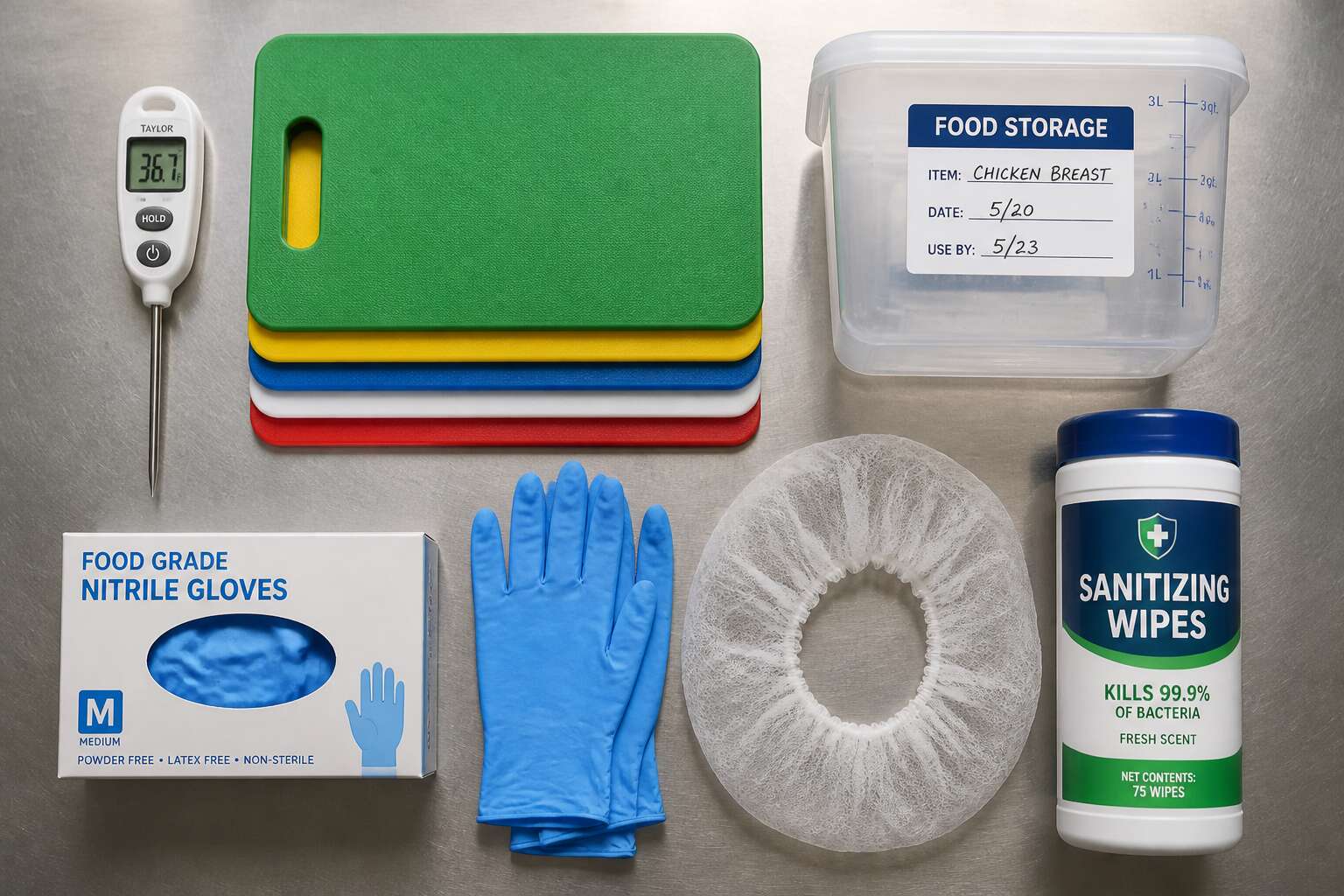
Temperature Monitoring Tools
Digital Probe Thermometers
A single degree can separate a perfectly cooked fillet from a dangerous bacterial bloom. Digital probe thermometers remove that uncertainty. These tools read core temperatures in seconds, letting you verify doneness without slicing into the product. For South African kitchens, where frequent power interruptions threaten chilled storage, a dependable probe offers immediate reassurance.
What earns a thermometer a permanent spot on any food safety equipment list?
- Fast response for high turnover shifts
- Simple calibration to maintain accuracy
- Sealed construction to survive daily washing
Probes shine during batch cooking. A large pot of soup may reach the right temperature at the edge but remain tepid in the center. Inserting the probe into the thickest part reveals the truth. Knowing that truth prevents costly waste and, more importantly, shields guests from harm. Every serious kitchen keeps a probe ready.
Infrared Surface Thermometers
Infrared surface thermometers solve a different puzzle than probes. They read surface temperature from a distance, which makes them ideal for scanning griddles, fryer exteriors, and hot-holding trays without contaminating the surface or losing time. In a South African kitchen, where loadshedding forces rapid adjustments, this speed matters.
A single sweep across a bain-marie reveals cold spots in seconds. That instant feedback lets you react before food drifts into the danger zone. For any food safety equipment list, an infrared thermometer earns its place through sheer versatility.
Use it to check delivery trucks before accepting produce, to verify dishwasher final rinse heat, or to scan plates before service.
Data Logging Temperature Recorders
Every temperature reading exists for a single moment, then it is gone. Data logging temperature recorders capture those moments continuously, building an unbroken timeline of your cold chain. In a South African operation, loadshedding cycles test refrigeration constantly. A spot check at 09:00 tells you nothing about the temperature at 03:00 when the power dropped.
A data logger tracks:
- Ambient conditions during transport
- Defrost cycle performance
- Time spent above critical limits
The result is documented evidence of diligence. Inspectors accept it. Auditors request it. Any serious food safety equipment list should include a data logger for this reason alone.
Calibration Kits and Reference Standards
A thermometer that lies is worse than no thermometer at all. Calibration kits and reference standards exist to catch those errors before they reach your records. Any food safety equipment list that omits them is incomplete. Ice point and boiling point references give you a fixed reality to measure against, while certified reference thermometers act as the final word in disputes.
In South African facilities, where ambient heat can drift equipment readings, calibration is not a once a year ritual. It is a constant discipline. In my experience, a calibration kit with NIST traceable standards lets your team verify instruments on site. The process takes minutes!
Reference standards fall into a few categories:
- Ice point cells for low temperature verification
- Dry block calibrators for probe thermometers
- Certified liquid baths for high precision work
Each serves a purpose. A proper food safety equipment list includes these tools because an uncalibrated reading has no meaning. Inspectors know the difference.
Cleaning and Sanitizing Stations
Three-Compartment Sinks
Three-compartment sinks are mandatory for manual dishwashing in many South African food operations. They are not glamorous, but they perform a crucial role. Each station needs three basins: one for washing, one for rinsing, and one for sanitising. Without this separation, cross-contamination becomes a serious risk.
Your food safety equipment list should always include these stations. I have walked through busy kitchens where staff use a single sink for every step. That invites problems with hygiene and compliance.
Effective sanitising requires attention to detail. The wash water must stay above 43°C, and the sanitiser concentration must match the product label. Health inspectors often test this step first.
- Label each basin clearly.
- Change water when it looks cloudy.
- Test sanitiser strength with test strips.
A well maintained three-compartment sink gives you control over one of the most basic cleaning tasks.
Commercial Dishwashers
Commercial dishwashers are the workhorses of any busy kitchen. They handle the heavy lifting that three-compartment sinks cannot. But they are only as safe as the person operating them. I have seen countless operations fail because the machine runs at the wrong temperature.
Check the wash cycle reaches at least 65°C, and the rinse hits 82°C. These numbers are non-negotiable for killing bacteria! A commercial dishwasher with a proper sanitising cycle should be on every food safety equipment list. Without it, you rely on guesswork. Regular maintenance keeps the heat where it belongs:
- Verify the machine’s gauges monthly.
- Clean spray arms and filters daily.
- Monitor detergent and sanitiser levels.
Sanitizing Solution Dispensers
One missed dilution ratio can undo an entire cleaning shift! A cleaning and sanitising station needs more than a spray bottle and good intentions.
Sanitising solution dispensers remove the guesswork. They meter water and chemical concentrate to the exact parts per million your sanitiser requires. A station without a calibrated dispenser often leaves staff mixing from memory. In a busy South African kitchen, memory fails.
The station groups the dispenser, labelled buckets, cloths, and test strips in one marked place. Inside that station:
- The dispenser head connects to a sealed chemical drum.
- Buckets carry labels that match the chemical name.
- Test strips show the active concentration.
- A clean soak basin keeps cloths at the correct strength.
This station belongs on any food safety equipment list. A compact layout cuts down the chance of cross contamination during a busy shift.
High-Pressure Washers
A cleaning station without high-pressure backup is a compromise. In South African food facilities, the grime on walls, drains, and equipment frames collects biofilm that wipes cannot touch. High-pressure washers break that film away before sanitising chemicals ever meet the surface.
I have walked through kitchens where the three-compartment sink shines but the wall behind it tells another story. That wall matters! The station itself needs defined zones, and any food safety equipment list should account for them:
- A dedicated area for soiled tools returning from the production floor
- A separate rack for freshly cleaned utensils
- A pressure washer with a spray gun rated for food industry use
- A drain that handles runoff without pooling
These washers earn their place when grease has baked onto stainless steel. A hand brush leaves streaks. Pressurised water reaches the crevices where bacteria colonise. Any food safety equipment list that omits a pressure washer leaves a gap between visible cleanliness and actual hygiene.
Utensil and Cutting Board Washers
Cutting boards often carry the highest pathogen load of any surface in a commercial kitchen. A battered board with knife scars provides perfect hiding spots for bacteria. A standard dishwasher cannot consistently deliver the thermal and chemical punch these items require. That is why a dedicated utensil and cutting board washer belongs on any food safety equipment list for South African food facilities.
These washers operate with a pre-wash phase, a high-temperature wash, and a sanitising rinse that exceeds 82°C. They also handle the volume. When you process hundreds of boards per shift, manual scrubbing falls short. Consider what a proper unit should offer:
- A rack system that separates utensils and boards to prevent nesting
- An internal booster heater that guarantees water temperature despite power fluctuations
- A dwell cycle that holds sanitising solutions for the required contact time
Without this equipment, your food safety equipment list leaves a critical gap between clean-looking tools and truly hygienic ones.
Personal Protective Equipment
Disposable Gloves
In a bustling Johannesburg kitchen, the quiet barrier between a chef’s hands and a plate of food is often a thin layer of nitrile. Gloves prevent cross contamination when handling raw proteins or ready to eat meals. South African health regulations demand vigilance! A tear in a glove can undo hours of careful temperature monitoring. This is why a complete food safety equipment list always includes a robust supply of disposable gloves.
A worker moves from raw chicken to salad. The glove changes, the risk drops. Common options include:
- Polyethylene for short, dry tasks.
- Nitrile for fatty foods and chemical resistance.
- Vinyl for low risk handling.
- Latex for tactile sensitivity.
The glove is a one time shield, discarded after every interaction. Any safety protocol without this humble item is a false promise of protection.
Hair Restraints and Beard Covers
Hair restraints are a critical item in any food safety equipment list. A single strand can carry Staphylococcus aureus, and in a Johannesburg kitchen, that means a bad review and a worse stomach ache. Yet many cooks wear hairnets at a jaunty angle, which defeats the purpose entirely.
Beard covers deserve equal respect. That glorious beard may win compliments, but it also sheds microscopic debris into the biltong. Options include:
- Disposable bouffant caps
- Mesh beard snoods
- Full face hoods for the luxurious types
The key is full coverage. Ears are often forgotten, and they shed too. A proper restraint system keeps every follicle contained. Remember, a rogue hair in the chakalaka is a career ender.
Cut-Resistant Gloves and Aprons
There is a particular silence in a Durban kitchen after a knife slips. It is the silence before the blood appears. Cut resistant gloves exist to prevent that moment. I have watched line cooks shrug them off, convinced the mesh would slow their hands. It does not! The modern weave sits close to the skin, flexible and unforgiving to steel.
Aprons are equally vital in this defence. They stand between your skin and the quiet injuries that accumulate over a career:
- The splatter of hot oil
- The scrape of a grater
- The stray edge of a bone
A proper apron stops these before they start. For the full catalogue of protective gear, a food safety equipment list must include both gloves and aprons. Without them, you carry the cuts, burns, and scars of the trade.
Storage and Holding Units
Reach-In Refrigerators and Freezers
Every food safety equipment list earns its keep at the cold storage line. Reach-in refrigerators and freezers hold the temperature boundary that separates safe food from a silent outbreak.
These units hide their failures well. Worn gaskets leak warm air, frost builds where airflow stalls, and the compressor works harder under South African ambient heat. The interior can drift out of range without any obvious sign.
- Check door seals for tears and trapped debris
- Arrange stock so cold air circulates freely
- Verify internal temperatures with a calibrated probe
A reach-in that fails quietly is more dangerous than a forgotten sanitising step. The unit looks fine, the food feels cold to the touch, but the pathogen load is climbing inside every container.
Hot Holding Cabinets
Hot holding cabinets do not cook food. They preserve a temperature that keeps pathogens from multiplying. In South African catering, the gap between preparation and service can stretch for hours, and that gap is where a food safety equipment list earns its practical value.
A cabinet that reads 65°C on the display may hold cold spots near the door. The air inside moves in patterns, and those patterns shift each time the door opens. Operators should test the actual food temperature with a probe, not the ambient reading.
- Confirm the thermostat against a calibrated probe every shift
- Stir or rotate food containers to break up stagnant zones
- Preheat the cabinet before loading it with hot food
These units only protect what you put into them. If the food enters below 60°C, the cabinet becomes a hazard that no food safety equipment list can fix.
Cold Storage Shelving Systems
Cold storage shelving systems often decide whether a walk-in unit keeps its promise. Air needs room to travel around every crate and tray. Solid shelves block that movement, creating pockets where temperatures climb above safe limits.
Perforated or wire shelving permits cold air to circulate freely. South African kitchens that stack goods directly on the floor invite contamination from mopping water and dust. Off-floor storage separates food from those hazards.
- Removable shelf panels simplify deep cleaning between stock rotations
- Shelf spacing must accommodate the tallest containers used during service
Every food safety equipment list should treat shelving as part of the cold chain, not an afterthought. The unit itself is only half of the equation.
Temperature-Controlled Transport Containers
At 11am in Gauteng, the sun turns a delivery van into an oven. A tray of chilled salads can cross the danger zone between 5°C and 60°C in under two hours without proper protection. Temperature controlled transport containers are the final defence between a hygienic kitchen and the customer’s table.
Passive cooling systems rely on phase change gel packs or eutectic plates sealed inside rigid plastic shells. The secret lies in the container’s thermal mass. A 40mm thick polyurethane core outperforms five times its weight in ice. South African caterers serving distant sites must match container volume to load density. A half-empty box loses cold air every time the lid opens.
- Choose containers with recessed latches that survive forklift handling
- Verify gasket seals annually for warping and hairline cracks
- Stackable units with drainage plugs allow ice melt to be removed without tilting
Every food safety equipment list should treat these units as assets, not accessories. Their role is to buffer the gap between preparation and arrival. Regular cleaning with approved sanitisers prevents biofilm build up inside the walls. Mark each unit with a unique tracking number so temperature logs can be traced back to a specific container on a specific route.
Ice Makers and Ice Bins
Ice acts as a food ingredient, not a luxury. If your ice maker or ice bin develops scale, the machines become breeding grounds for Pseudomonas. In a Durban summer, this can shut down a catering operation within hours. Add both units to your food safety equipment list with clear responsibilities.
Each morning, inspect the ice chute for slime and wipe down the bin’s interior. A dedicated food-grade scoop should never rest inside the ice, as the handle picks up grime from nearby surfaces. I have seen kitchens replace an expensive ice machine only to find biofilm persisting in the adjacent bin.
- Store scoops in a mounted cradle away from drip lines
- Date and rotate full bins to prevent melt and refreeze cycles
- Include a water filter replacement schedule for the maker
Condensate pans deserve monthly descaling, since airborne flour and dust gum up the fins quickly. Your food safety equipment list should pair each ice maker with a bin that drains completely to avoid standing water. Standalone ice bins for mobile catering need secure lids and raised legs to keep them clear of floor wash water. The cold chain does not end at the freezer door; it extends to every cube that lands in a glass.
Food-Grade Storage Containers and Bins
An unmarked plastic bucket is not a food-grade container. The polymer composition differs, and acidic ingredients can leach chemicals from non compliant plastics. That is why the food safety equipment list must specify containers with the glass and fork symbol, along with the polyethylene or polypropylene designation. I have watched kitchens fail inspections simply because they swapped a cracked bin with a household storage box.
Stacking systems often hide grime when the rims distort. A warped lid allows moisture to collect, and that invites mould inside the holding unit. In South African catering environments, UV exposure and heat make cheap plastics brittle quickly. Bins kept in direct sunlight develop stress fractures in months, not years. The full equipment list should pair each container with a cover that seals completely instead of relying on loose plastic sheeting.
Contaminant Detection Devices
Metal Detectors for Processed Foods
Metal detectors for processed foods reveal a sobering truth: contamination is rarely intentional, yet it happens. A single stainless steel shard from worn machinery can derail an entire production line. In South Africa, where high throughput meets aggressive processing environments, these devices serve as the final sentinel between a factory floor and a consumer’s table. When assembling a food safety equipment list, their presence is non-negotiable.
Modern units distinguish between the product’s own conductivity and foreign metal signatures, a nuance that demands precise frequency tuning. They operate in three essential modes:
- Ferrous detection for iron and steel fragments
- Non-ferrous detection for aluminum and copper
- Stainless steel detection, the most elusive due to lower conductivity
That third category often humbles operators. Processed meats, sauces, and canned goods each require unique calibration, because moisture and salt content create misleading signals. Without these detectors, a single overlooked fragment becomes a liability, not just a quality issue. The equipment does not judge; it simply measures what we might otherwise miss.
X-Ray Inspection Systems
When assembling a food safety equipment list, X-ray inspection systems deserve careful consideration. While metal detectors target metallic fragments, these units reveal glass shards, dense plastics, and calcified bone. The imaging process uses dual-energy sensors to compare atomic density, exposing contaminants that would otherwise pass unnoticed.
- Glass from broken lighting or jars
- Stones and mineral grit
- Bone fragments in deboned meat
I have seen South African facilities deploy these systems for poultry and canned goods with remarkable results. The equipment also verifies product weight and fill levels, adding production data to its safety role. The capital investment is significant, but the cost of a single recall far exceeds the price of prevention.
Magnet Traps and Sieves
Magnet traps and sieves rarely attract attention, yet they belong on any serious food safety equipment list. These unglamorous devices work quietly at critical points in production lines, capturing ferrous fragments and oversized particles that other detectors cannot catch. In South African maize mills, magnet traps pull metal dust from high volume grain flows, while sieves separate husks and clumped powder before packaging.
Typical installation points include:
- Raw material intake hoppers
- Transfer points between conveyors
- Just before filling or bagging stations
The effectiveness depends on regular cleaning. A clogged sieve or saturated magnet becomes a liability. These tools offer a low cost, mechanical safeguard that complements electronic inspection systems.
Foreign Object Pickup Tools
An alarm sounds. A line stops. Now what? Contaminant detection devices are only half the story. The other half is what happens after detection. In South African food facilities, we see foreign object pickup tools earn their place at this exact moment.
Precision tweezers pull glass shards from sorting tables. Magnetic wands reach into crevices where fixed detectors cannot go. Vacuum tools collect fine metal dust from packaging surfaces. Each tool serves a specific purpose.
Common foreign object pickup tools:
– Fine-tipped stainless tweezers for glass fragments
– Telescopic magnetic wands for ferrous debris
– Vacuum pickups for fine dust and powders
– Scrapers for sticky or embedded material
A serious food safety equipment list includes both the devices that find contamination and the tools that remove it. You cannot skip the second part.

0 Comments