The Role of a Centralized Fire Safety Hub
Why Consolidating Equipment Matters
In South Africa, fire departments respond to over 20,000 structural fires each year. Every second matters. A centralized hub changes how you store and access vital tools. But why does consolidating equipment matter so much? A fire safety equipment board puts all your gear in one visible, orderly location. No more rummaging through cabinets or risking misplaced extinguishers. You need to grab items quickly, not hunt for them.
- Fire extinguishers and blankets
- Hoses and nozzles
- Alarms and detection units
- First aid kits and gloves
When these essentials live on one board, inspections become simple. You can spot missing items instantly. This approach cuts response time and keeps your building compliant. We have seen it turn chaotic storerooms into efficient stations. The fire safety equipment board is not a luxury. It is a necessity for every workplace.
How a Fire Safety Station Improves Emergency Response
Fire doubles in size every sixty seconds. A misplaced extinguisher can cost you that entire window. A fire safety equipment board removes the guesswork. It puts every tool in a designated, visible location. No more searching. No more delay.
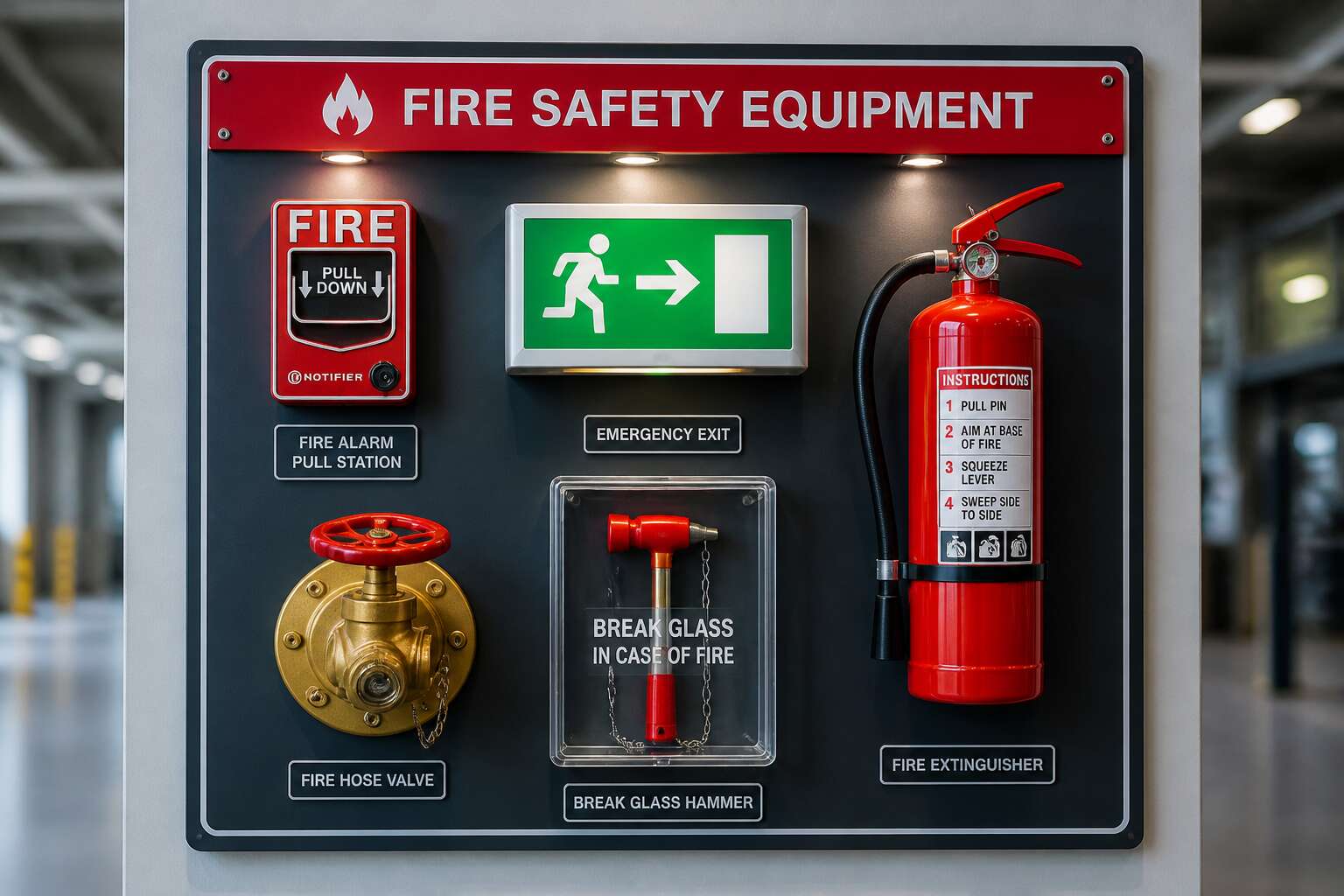
A centralized hub turns scattered gear into one logical station. Extinguishers, blankets, hoses, and alarms live together. The layout stays consistent, so a new employee knows exactly where to reach. This fire safety equipment board improves emergency response because nothing is hidden.
When the alarm sounds, your team grabs the right item immediately. We have seen response times drop from minutes to seconds! No fumbling. No hesitation. What belongs on the station?
- Fire extinguishers and spare blankets
- Hoses and nozzles
- Detection units and spare batteries
- First aid kits and gloves
One glance. Everything accounted for. Nothing to search. Nothing to second guess.
Common Industries That Benefit
The fire safety equipment board does something subtle: it replaces frantic memory with orderly perception. In an emergency, the brain narrows its focus. A centralized hub becomes the one reference point. I have seen this in action at a Durban packaging plant, where the board converted panic into procedure.
Industries with high staff turnover gain the most. No lengthy induction is required.
- Hospitality venues
- Retail and warehousing
- Educational facilities
- Workshops and fabrication
A fire safety equipment board also carries moral weight. It signals that every life in the building matters enough to be anticipated.
Key Differences Between a Board and a Cabinet
A fire safety equipment board is a communication device, while a cabinet is simply a storage unit. The cabinet keeps extinguishers and hoses neat, but it hides them behind a door. The board puts the inventory in plain sight, along with instructions and accountability checks. This distinction matters during a live emergency. People react to what they see, not what they remember.
Consider the basic differences:
- A cabinet prioritises protection of the equipment.
- A board prioritises access to the information.
- A cabinet requires you to open and search.
- A board shows you exactly what is needed and where.
The centralised hub turns the fire safety equipment board into the reference point of the emergency plan. It works because it removes guesswork. In a factory or open-plan office, staff can locate the correct extinguisher without reading every label. That makes the board the first place the eye goes when alarms sound.
Must-Have Items for Your Fire Safety Display
Fire Extinguishers: Types and Placement
A fire extinguisher on the wrong wall is just a tin can. Placement decides everything. Your fire safety equipment board should anchor these devices where hands instinctively reach, not where the aesthetics demand.
The board needs a clear hierarchy. Extinguishers take the central slot, positioned at eye level and away from potential heat sources. South African regulations under SANS 10400 specify distances based on risk classes. That means sorting types before mounting.
- Class A for wood, paper, and textiles
- Class B for petrol, oils, and solvents
- Class C for live electrical equipment
Match the unit to the hazard. Locate the board near an exit but free from obstructions. The fire safety equipment board becomes your first action point. Check the pressure gauge monthly. Confirm the pin is locked. Direct access saves seconds, and seconds save everything.
Alarm and Detection Devices
A fire safety equipment board without alarm and detection devices serves no warning function. Smoke detectors catch the first trace of combustion. Heat sensors respond where smoke builds too slowly. Manual call points let a person raise the alarm within seconds, and in a sprawling warehouse or a busy office floor, those seconds are the difference between a contained incident and a spreading one.
Each detector type performs a distinct role:
- Optical smoke detectors sense slow, smouldering fires
- Ionisation detectors catch fast, flaming fires
- Rate-of-rise heat sensors react to sudden temperature shifts
These devices give the fire safety equipment board its operational purpose. The alarm sounds before an extinguisher is ever lifted, which is the order every emergency depends on.
Emergency Lighting and Signage
In a smoke-filled corridor, visibility drops to less than one metre within seconds. Emergency lighting and signage give the fire safety equipment board its purpose when power fails and exit routes disappear. These elements operate without attention until the moment they matter.
A functional display should incorporate:
- An illuminated sign marking the board’s own location
- Escape route signage aligned with the building’s layout
- Emergency luminaires covering corridors, stairwells, and assembly points
South African buildings must follow SANS 10400 and SANS 1465. Photoluminescent signs function without mains power. Battery-backed lighting sustains brightness for at least three hours. The fire safety equipment board itself carries a clear identification sign, with lighting directed at the equipment for quick access during an outage.
First Aid and Rescue Tools
Severe burns demand treatment within the first minute. That urgency makes first aid and rescue tools an essential part of any fire safety equipment board. These items handle what extinguishers and alarms cannot: direct care for injured people and physical extrication.
The board should carry burn dressings, sterile saline, and trauma shears. A fire blanket smothers clothing flames. A pry bar or axe helps rescue someone pinned by debris.
A practical layout might include:
- Burn care supplies
- Fire blanket
- Rescue tools
Keep the fire safety equipment board clear of obstructions. Stored tools lose value if they are buried behind clutter. Regular checks confirm supplies remain sealed and ready.
Inspection Tags and Record-Keeping Supplies
An inspection tag is a quiet record keeper. It preserves the last time someone verified the extinguisher pressure, the blanket seal, the saline expiry. Without these markers, a fire safety equipment board can hold silent failures. The equipment looks ready. The records tell the real story.
Record keeping turns a board into a documented system. Log sheets, pens, and a weatherproof pouch keep the inspection history within reach. Each dated signature is a moment of attention.
- Inspection tags with date and signature lines
- A laminated log sheet or bound register
- Permanent markers that endure dust and heat
Auditors and safety officers read these records first. On a fire safety equipment board, the paper trail carries as much weight as the equipment itself.
Design and Layout Best Practices
Selecting the Right Location and Height
The best fire safety equipment board in the world is useless if it sits behind a filing cabinet. Placement dictates response time, and response time dictates survival odds! I have seen South African facilities mount boards at ankle height, forcing panicked staff to crouch and fumble in smoke.
Mount it between 1.2 and 1.5 metres above the floor. Position it along primary escape routes, never near heat sources or in dead-end corners. Consider these factors when choosing the spot:
- Line of sight from high-traffic zones
- Clearance from doors that swing open
- Distance from potential ignition points
A poorly placed board becomes a liability. Make sure the location works for the people who need it, not just the compliance officer who signed off.
Organizing Equipment for Quick Access
Seconds vanish in smoke. A fire safety equipment board that buries a hose under a tangle of cables delays the responder. Layout should follow response sequence, not symmetry. Put the extinguisher first, then the blanket, then the torch. Group by task, not by size.
- Extinguisher and fire blanket at chest height
- Gloves and a pry bar below, within reach
- Spare bulbs and batteries in a sealed container
Use reflective labels and colour coded zones. Heavy tools go low, fragile items go high. A well organised board shortens response time. Instinct takes over when the arrangement holds.
Using Visual Cues and Color Coding
Your eyes do the thinking when your brain is busy! A fire safety equipment board that uses color coding turns a panicked scan into a reflex. Red for suppression, green for first aid, yellow for tools. This is not decoration; it is wayfinding. In a smoke filled room, those hues remain visible longer than most labels. Pair them with reflective tape and simple icons.
- Red for extinguishers and hoses
- Green for blankets and first aid
- Yellow for pry bars and gloves
A small legend beneath the board clarifies the system. Every responder must know the palette before an incident occurs. Local fire codes often require contrast, so use dark backgrounds with bright zones. A consistent colour scheme across every fire safety equipment board in your facility removes guesswork. Consistency shortens response time.
Installation and Mounting Guidelines
Wall-Mounting vs. Stand-Alone Units
A fire safety equipment board fixed to a hollow wall is a fiction of preparedness. The mounting method determines whether the board holds up in an emergency or becomes a hazard itself. Wall mounting suits permanent facilities where the layout will not change for years. It keeps extinguishers at a predictable height, away from mop buckets and passing trolleys. Stand alone units suit rented spaces where drilling into brickwork is not permitted. They can be repositioned when storage racks shift or when a new lease forces a new floor plan.
Consider the following when choosing:
- Wall mounted boards require a solid backing. A stud wall will not support two extinguishers and a trauma kit.
- Stand alone units require a weighted base to resist tipping near open doors or high traffic aisles.
- Both need clear floor space, roughly one metre in front of the board, for someone crouching to reach a lower shelf.
The top of the fire safety equipment board should sit at the eye level of the shortest user. Mounting height is a safety calculation, not a convenience.
Clearance and Accessibility Requirements
The SANS 10105 standard does not care about your storage habits. It cares about a clear, unobstructed path to the fire safety equipment board. Every regulation demands a specific clearance. This is a measurement exercise with a tape.
The mounting process starts with a static load test. The wall must be solid masonry or steel framing. Use anchors rated for the total weight of the board, its contents, and the torque of a panicked tug. The board bolted to hollow drywall will fail the first time someone pulls an extinguisher free.
The floor in front must be level and free of rubber mats that bunch. The clearance rules are strict:
– A minimum of 1 metre of unobstructed floor space in front.
– At least 0.5 metres of clearance on either side for a two-handed grab.
– A clear line of sight from the main walkway.
A door swing that hits the board counts as an obstruction. The fire safety equipment board needs a clear envelope, not an occasional path.
Protecting Equipment from Damage and Tampering
The mounting process for a fire safety equipment board is a structural commitment. I have watched crews anchor boards to hollow drywall with standard wall plugs. The first time someone rips an extinguisher free, the whole unit tears from the wall. That panic moment is exactly when the equipment must hold firm!
Protecting the board from damage starts with placement. Vibration from nearby machinery loosens fittings. Direct sunlight fades signage and degrades plastic. Moisture from a leaking roof corrodes the hardware. Each threat shortens the working life of the station.
Tamper resistance requires deliberate design:
- Lockable covers or break-glass mechanisms deter interference without slowing response
- Tamper-evident seals and locking pins expose any meddling
- Spare keys stay with security personnel, not near the board
A fire safety equipment board that is hard to reach in an emergency is worse than none at all.
Integrating with Building Infrastructure
A fire safety equipment board relies entirely on the structural substrate behind it. In South African commercial buildings, lightweight partitions often conceal steel studs with poor pull-out strength. When someone rips an extinguisher free during an emergency, the whole assembly can detach. I have seen fire safety equipment board installations fail because the mounting crew never verified the wall composition.
Before drilling, retrieve the structural drawings. Concrete and masonry accept mechanical anchors into the load path. For hollow stud walls, specify toggle bolts rated for the combined dead load of the board and its contents. Install plywood backing plates within the cavity when possible.
Coordinate with other trades before committing to a location. Electrical conduits and HVAC plenums occupy the same wall cavity. Penetrating a fire-rated assembly without resealing compromises the building’s compartmentation. Apply fire-rated sealant around every anchor point.
Maintenance, Compliance, and Training
Routine Inspection Checklists
Routine inspection of a fire safety equipment board is a discipline many facilities overlook. It is not enough to install the board correctly once. Without regular checks, equipment drifts into disrepair, and compliance claims lose their footing.
A sustained maintenance schedule should include:
– Verifying that every device is present and unobstructed
– Confirming seals and tamper indicators remain intact
– Testing audible and visual alerts for clear function
– Recording faults in the facility logbook
Training routines keep these checks honest. Staff who practice the inspection monthly learn to identify deviations quickly and accurately. They notice small changes before they become failures. When auditors arrive, the maintenance trail is clear. The fire safety equipment board becomes proof of a working system, not a decorative wall feature.
Servicing and Recharging Equipment
Servicing and recharging equipment follows a strict calendar, and the calendar does not pause for busy facility managers. Every extinguisher, hose, and alarm on a fire safety equipment board carries its own expiration date. In South Africa, accredited technicians must inspect and recharge these devices at regulated intervals. Missing those windows compromises both safety and legal standing.
Training converts this schedule into daily awareness. We teach staff to read pressure gauges, spot cracked hoses, and verify that tamper seals remain unbroken. This protects the investment in the fire safety equipment board. It also protects the people who depend on it.
Each service event must be documented:
- Date of service
- Technician name and credentials
- Recharge or replacement actions taken
- Next scheduled service date
Compliance depends on this documentation. Auditors look for a continuous trail, and they often check service records before inspecting the physical units. A well serviced fire safety equipment board proves the system works.
Documentation and Audit Trails
Records often outlive the people who created them. For any fire safety equipment board, that documentation is what auditors examine first. Maintenance logs and training records must stand on their own, because the technicians who signed them may no longer be around to explain their decisions.
South African compliance officers look for continuity. They want to see a documented chain that connects every drill, every inspection, and every certification to a specific date and individual. When gaps appear, they ask uncomfortable questions:
- Who missed the service window?
- What else was overlooked?
- Which units went unchecked?
Training documentation deserves equal attention! When staff complete fire awareness sessions, record the roster, the content covered, and the results. This satisfies compliance and proves that the fire safety equipment board remains supported by people who understand its operation.
Training Staff on Proper Usage
Maintenance is what makes a fire safety equipment board functional. A unit that looks intact can still harbour a depressurised extinguisher or a corroded hose. Schedule inspections with function in mind. Replace worn seals, test pressure gauges, and confirm that every device operates as intended.
Compliance in South Africa follows the Occupational Health and Safety Act. That law expects employers to provide and maintain fire fighting equipment. The board itself becomes part of that proof when its condition reflects regular servicing.
Training staff on proper usage turns a passive installation into an active defence. People freeze when they do not know what to do. Hands-on drills with the actual fire safety equipment board reduce that paralysis. Teach staff to:
- Remove the pin and aim the extinguisher correctly
- Read the inspection tag and identify expired units
- Locate the emergency release mechanism
Repetition determines whether a person hesitates or responds.
Upgrading Your Fire Safety Setup
Upgrading a fire safety equipment board takes more than buying a fresh unit. Maintenance becomes the pulse that keeps it relevant. Every seal, gauge, and hose must be tested against the manufacturer’s current specifications, not just the old checklist. A small retrofit here can prevent obsolescence from creeping into your fire safety equipment board.
Compliance under the Occupational Health and Safety Act requires the board to mirror the latest legal expectations. That means updating signage, adjusting mounting heights, and logging each service event in a format inspectors can follow without a magnifying glass. In South Africa, a board that sits unchanged while regulations move forward becomes a quiet liability.
Training staff on those upgrades turns a static installation into a responsive tool. I have watched teams hesitate when a board suddenly looks different. Short, repeated sessions with the actual unit build the muscle memory. An upgrade is complete only when the team knows exactly what to do with it.


0 Comments